
Investor education from the Vanderbiltreport Team. Statements labelled Verified come from SEC forms, bulletins and releases linked in the text; passages labelled Analysis are our explanatory commentary. Nothing here is an investment recommendation.
Every U.S. public company tells its own story in press releases and investor decks. The Form 10-K is where it has to tell the whole story, under legal liability, in a format regulators prescribe. Learning how to read a 10-K is one of the most useful skills an individual investor can build — and you do not need an accounting degree to do it.
This guide walks through the annual report section by section, shows you where the most useful information usually sits, and offers a practical 30-minute reading order.
What Is a Form 10-K?
Verified: The 10-K is the comprehensive annual report that U.S. public companies file with the Securities and Exchange Commission. The SEC’s investor bulletin How to Read a 10-K notes that it is more detailed than the glossy annual report many companies mail to shareholders, although some companies simply use the 10-K for both purposes.
Verified: Under the Sarbanes-Oxley Act, the company’s CEO and CFO must certify the accuracy of the 10-K. Those certifications normally appear as Exhibits 31 and 32. The same law requires the SEC to review each public company’s filings at least once every three years.
When is it filed?
Verified: The instructions to the current Form 10-K set the deadline by company size:
| Filer category | 10-K deadline after fiscal year-end |
|---|---|
| Large accelerated filers | 60 days |
| Accelerated filers | 75 days |
| All other registrants | 90 days |
Analysis: For a calendar-year company that means the 10-K usually lands between late February and the end of March. A late filing (watch for Form NT 10-K) is worth noticing, particularly for smaller companies.
The Map: What Is in Each Part of a 10-K
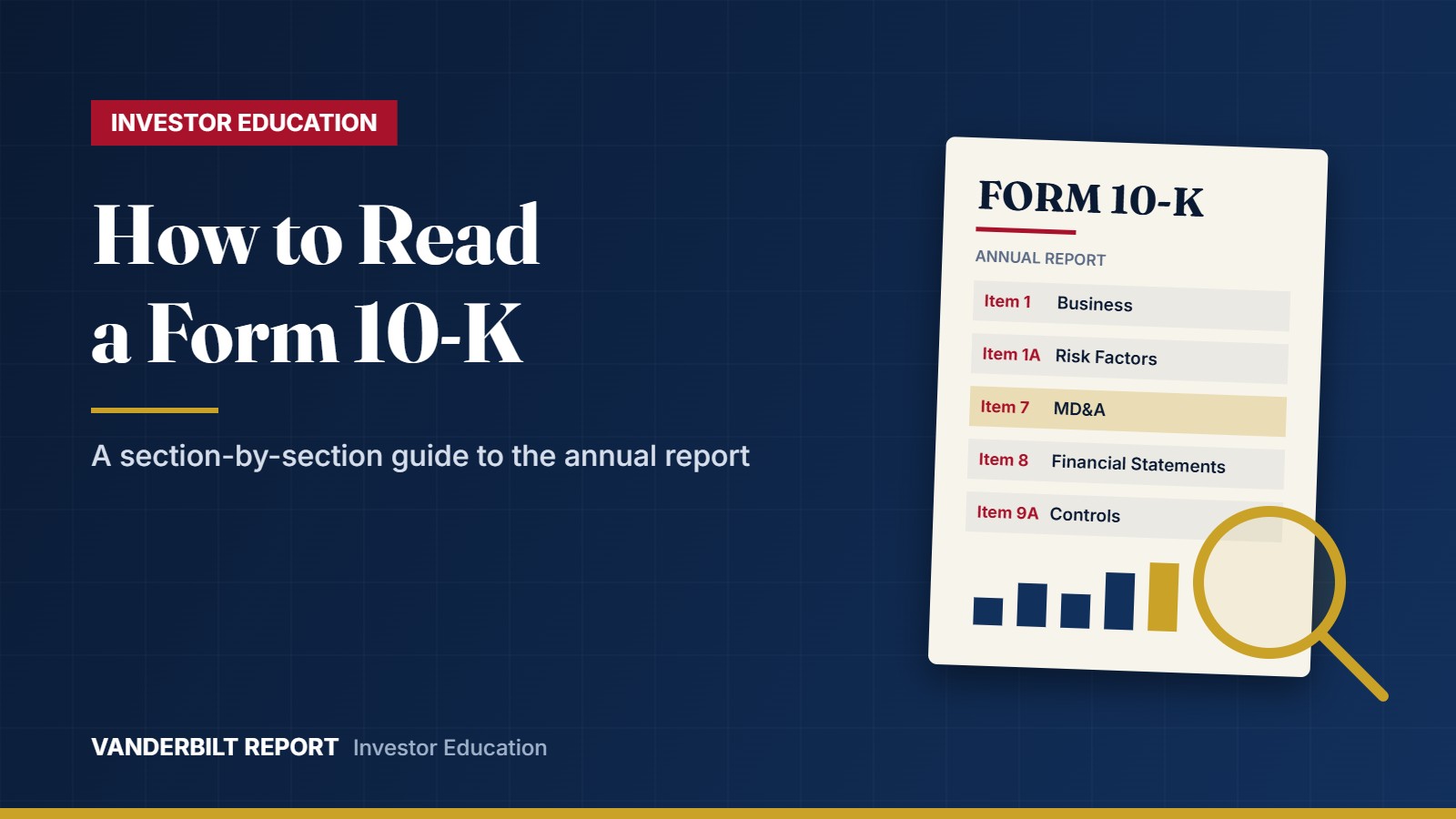
| Item | Title | What to look for |
|---|---|---|
| Part I — The business and its risks | ||
| 1 | Business | What the company sells, to whom, how it competes, headcount, regulation |
| 1A | Risk Factors | The risks management considers most significant |
| 1B | Unresolved Staff Comments | Open questions from SEC reviewers |
| 1C | Cybersecurity | How cyber risk is managed and overseen |
| 2 | Properties | Significant plants, offices, mines and other physical assets |
| 3 | Legal Proceedings | Material lawsuits and regulatory actions |
| 4 | Mine Safety Disclosures | Applies to mining operators |
| Part II — The numbers and management’s explanation | ||
| 5 | Market for Common Equity | Where shares trade, holders of record, dividends, buybacks |
| 6 | [Reserved] | No longer used |
| 7 | Management’s Discussion and Analysis (MD&A) | Why results changed; liquidity and capital resources |
| 7A | Market Risk Disclosures | Exposure to interest rates, currencies, commodities |
| 8 | Financial Statements | Audited statements, the auditor’s report and the footnotes |
| 9 | Changes in and Disagreements With Accountants | Auditor changes and disputes |
| 9A | Controls and Procedures | Whether internal controls are effective; any material weakness |
| 9B | Other Information | Items that should have been reported earlier; insider trading plans |
| 9C | Foreign Jurisdictions that Prevent Inspections | Relevant where audit inspections are blocked abroad |
| Part III — The people | ||
| 10–14 | Directors and officers, executive pay, ownership, related-party transactions, auditor fees | Often incorporated by reference from the proxy statement |
| Part IV — Exhibits | ||
| 15–16 | Exhibits, financial statement schedules, optional summary | Material contracts, subsidiaries list, certifications |
The Five Sections That Repay Your Time
1. Item 1 — Business
Analysis: Start here if the company is new to you. Look for how revenue is actually generated, whether a handful of customers account for a large share of sales, how dependent the company is on a single product, supplier or licence, and how management describes the competition.
2. Item 1A — Risk Factors
Verified: The SEC bulletin explains that this section sets out the most significant risks facing the company, typically in order of importance.
Analysis: Much of the language is boilerplate. The value is in what is specific and what is new. Comparing this year’s risk factors with last year’s is one of the fastest ways to see what has started to worry management.
3. Item 7 — MD&A
Analysis: This is management explaining the numbers in its own words. Focus on three things: the stated reasons revenue and margins moved, the liquidity discussion (how much cash, how long it lasts, what financing is planned), and any known trends or uncertainties management says could affect future results.
4. Item 8 — Financial Statements and Footnotes
Verified: Item 8 contains the company’s audited financial statements, prepared under U.S. generally accepted accounting principles, together with the independent auditor’s report.
Analysis: Read the auditor’s report first. It is short, and any “going concern” paragraph — the auditor’s statement of substantial doubt about the company’s ability to keep operating — will be there. Then compare net income with cash flow from operations, and skim the footnotes on debt, share-based compensation, related parties and subsequent events.
5. Item 9A — Controls and Procedures
Analysis: If management discloses a “material weakness” in internal control, the company is telling you its financial reporting process has a serious gap. It is not proof the numbers are wrong, but it is a reason for extra care.
Red Flags Worth a Second Look
- A going-concern paragraph in the auditor’s report.
- A change of auditor disclosed in Item 9, especially with a reported disagreement.
- A material weakness in Item 9A, or a restatement of prior results.
- Profits on the income statement but persistently negative operating cash flow.
- Heavy reliance on one customer, supplier or short-term lender.
- Significant related-party transactions.
- Rapid growth in the share count from convertible notes, warrants or repeated offerings.
- New, company-specific risk factors that were not there last year.
Analysis: None of these is automatically disqualifying. Each is a prompt to read further and ask why. Smaller companies — including many that trade over the counter — may also qualify for scaled-down disclosure, so their 10-Ks can be shorter than those of large companies.
A 30-Minute Reading Plan
- Minutes 0–5: Cover page and Item 1. Confirm what the company does, its filer status and shares outstanding.
- Minutes 5–12: Item 7. Read the overview, results discussion and liquidity section.
- Minutes 12–20: Item 8. Auditor’s report, then the three main statements, then the debt and equity footnotes.
- Minutes 20–25: Item 1A. Skim headings; read anything specific or new.
- Minutes 25–30: Items 3, 9 and 9A. Lawsuits, auditor changes and control weaknesses.
Where to Find 10-K Filings
Verified: All 10-Ks are free on the SEC’s EDGAR database. Search by company name or ticker and filter by form type “10-K.” Most companies also post filings in the investor relations section of their websites.
10-K vs. 10-Q vs. 8-K
| Form | Frequency | Purpose |
|---|---|---|
| 10-K | Annual | Full-year audited report on the business, risks and finances |
| 10-Q | Quarterly (first three quarters) | Interim update with unaudited financial statements |
| 8-K | As events occur | Current report on significant events — see the SEC’s How to Read an 8-K |
Developing: On May 5, 2026, the SEC proposed rules that would let companies choose to file a semiannual report on a new Form 10-S instead of quarterly 10-Qs. At the time of writing this is a proposal, not a final rule, and the SEC said the annual 10-K requirement would not change. If adopted, the 10-K would carry even more weight for companies that report less often.
Frequently Asked Questions
Is the 10-K the same as the annual report?
Not always. The annual report to shareholders is often a shorter, designed document. The 10-K is the formal SEC filing and usually contains more detail. Some companies use the 10-K as both.
Is a 10-K audited?
The annual financial statements in Item 8 are audited by an independent accounting firm. Other sections, such as MD&A and risk factors, are management’s own disclosures.
How long is a typical 10-K?
It varies widely, from a few dozen pages for small companies to several hundred for large, complex ones. A focused reading plan matters more than reading every page.
Do foreign companies file a 10-K?
Many foreign companies listed in the U.S. file an annual report on Form 20-F or 40-F instead. The structure differs, but the same reading approach applies.
The Bottom Line
A 10-K rewards a plan. Read the business description, management’s explanation, the auditor’s report and the cash flow statement, then check the risk factors and controls for anything new. Thirty focused minutes with the primary document will tell you more than hours of commentary about it. For more guides like this, visit our Research Articles section.
Sources
- SEC Investor Bulletin — How to Read a 10-K
- SEC — Form 10-K and General Instructions
- Investor.gov — Form 10-K glossary entry
- SEC Investor Bulletin — How to Read an 8-K
- SEC — Proposed amendments to permit optional semiannual reporting (May 5, 2026)
- SEC — EDGAR full-text search
Publisher Disclaimer: Vanderbiltreport.com publishes news and information for general informational and educational purposes. Information is compiled from sources believed to be reliable, but Vanderbiltreport.com does not guarantee the accuracy, completeness, or timeliness of all information presented. Readers should independently verify information and conduct their own research before making financial, investment, business, or other decisions.