
By Vanderbiltreport Team | September 24, 2026
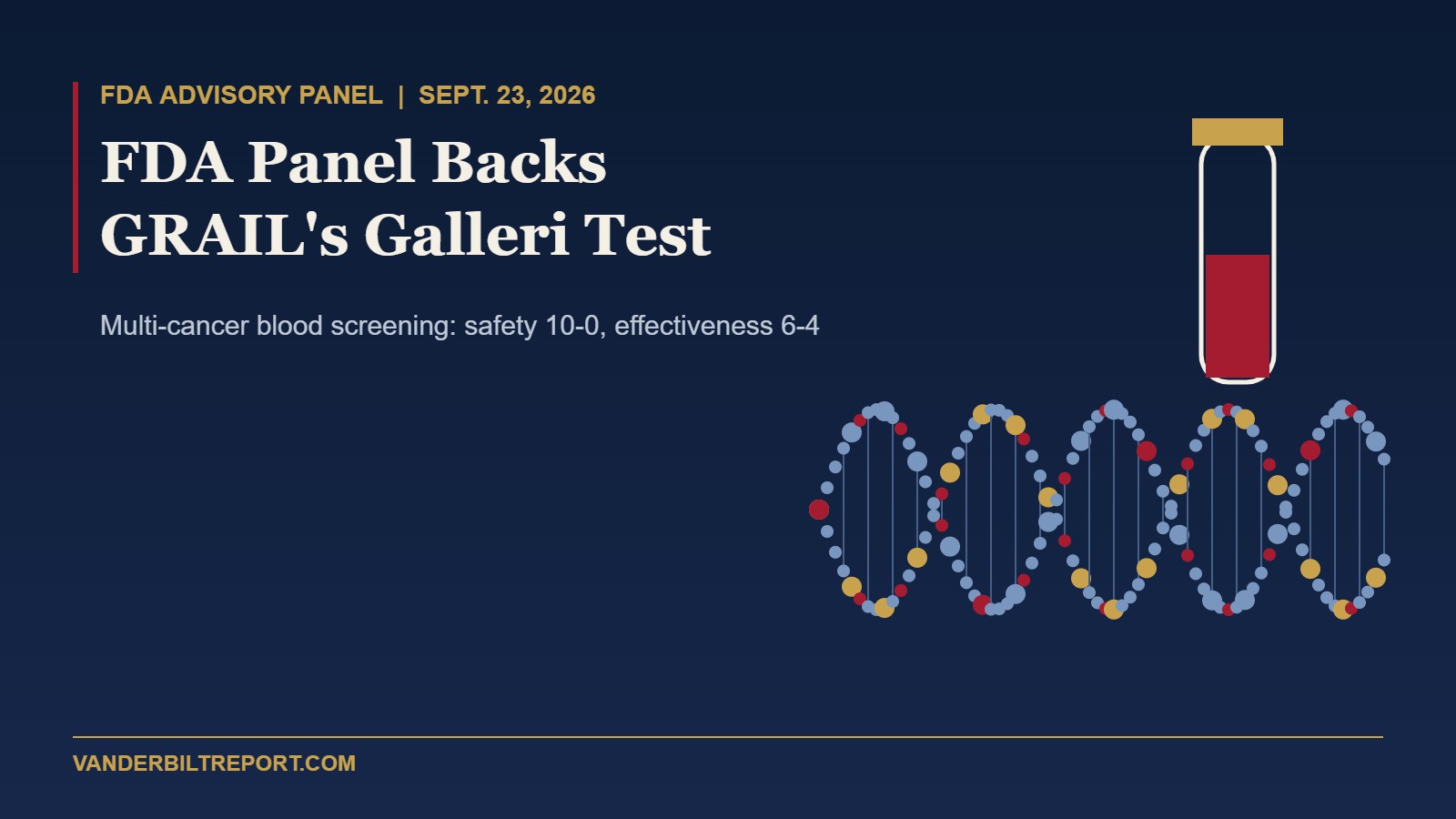
A federal advisory panel has voted in favor of the Galleri multi-cancer early detection test, the blood test developed by GRAIL, Inc. (NASDAQ: GRAL). The September 23 vote does not approve the test. It does move the first screening test of its kind one step closer to a Food and Drug Administration (FDA) decision.
The panel was split on the central question of effectiveness. Below we cover how each question was voted, what the trial data show, where the gaps are, and what happens next.
What Happened: The Panel’s Votes on the Galleri Multi-Cancer Early Detection Test
Verified facts. On September 23, 2026, the FDA’s Molecular and Clinical Genetics Panel of the Medical Devices Advisory Committee met at the FDA’s White Oak campus in Silver Spring, Maryland, to review GRAIL’s premarket approval (PMA) application for Galleri. Reports from CancerNetwork and GRAIL’s own release give the vote counts below.
| Question put to the panel | Result |
|---|---|
| Is there reasonable assurance the test is safe? | 10 yes, 0 no |
| Is there reasonable assurance the test is effective? | 6 yes, 4 no |
| Do the benefits outweigh the risks? | 7 yes, 2 no, 1 abstention |
FDA advisory panels give recommendations only. The agency makes the final decision and does not have to follow the vote.
Our Catalyst Watch for September 23–26 flagged this meeting ahead of time. This article covers what the panel actually decided.
What Galleri Is and Who It Is For
The FDA’s meeting notice describes Galleri as a qualitative, next-generation sequencing test. It looks for cancer-specific DNA methylation patterns in cell-free DNA taken from a blood sample.
- Proposed use: screening adults aged 50 and older.
- Result types: “cancer signal detected” or “no cancer signal detected.” A positive result comes with a predicted Cancer Signal Origin (CSO), meaning the tissue or organ the signal most likely comes from.
- Follow-up: a positive result must be confirmed with diagnostic workup by a healthcare professional.
GRAIL submitted the final module of its PMA on January 29, 2026, according to the company.
The Evidence: PATHFINDER 2 and NHS-Galleri
Two large studies were central to the review. Their results point in different directions, which helps explain the split vote on effectiveness.
PATHFINDER 2 (North America)
GRAIL presented PATHFINDER 2 at the 2026 ASCO Annual Meeting. The main figures reported for the 35,878 participants analyzed were:
| Metric (PATHFINDER 2) | Reported value |
|---|---|
| Cancer signal detection rate | 0.8% (287 participants) |
| Positive predictive value (PPV) | 60.3% |
| Specificity | 99.6% |
| Cancer Signal Origin accuracy | 91.3% |
| Episode sensitivity, all cancers | 39.3% |
| Episode sensitivity, 12 deadly cancers | 69.8% |
| New Galleri-detected cancers at stage I–II | 53.0% |
| Detected cancers with no USPSTF A/B screening option | 71.3% |
| Participants undergoing invasive procedures | 0.6% |
Source: GRAIL’s ASCO 2026 release. These are company-reported figures from a single-arm interventional study.
NHS-Galleri (England)
NHS-Galleri is a randomized controlled trial of 142,250 participants. CancerNetwork’s summary of the review reports that it showed no significant reduction in late-stage cancer diagnoses after three rounds of screening.
A post-hoc analysis found stage I or II cancers in 647 patients in the screening group, compared with 559 in the control group. Post-hoc analyses were not pre-specified, so they carry less weight than a trial’s primary endpoint.
Company Statements vs. Regulatory Caveats
Company statements. GRAIL says that across its studies, Galleri found “approximately four to seven times more cancers” than standard-of-care screening alone. It also says most of those cancers were found at earlier stages, with a low false-positive rate. GRAIL CEO Josh Ofman, MD, MSHS, said the test “was developed to improve the effectiveness and efficiency of our national cancer screening program.”
Regulatory caveats. FDA materials summarized by CancerNetwork say Galleri “is not a replacement for existing recommended single-cancer screening tests.” They also say “a result of no cancer signal detected does not rule out the presence of cancer.”
Limitations and Open Questions
- Effectiveness split: four of ten panelists voted no on effectiveness. That is the narrowest margin of the three votes.
- Stage-shift endpoint: the randomized NHS-Galleri trial did not meet its primary goal of significantly reducing late-stage diagnoses.
- Sensitivity: across all cancers, episode sensitivity in PATHFINDER 2 was 39.3%. The test misses many cancers, so a negative result is not an all-clear.
- Mortality: neither summary reports whether the test reduces cancer deaths.
- Follow-up burden: about 4 in 10 positive signals in PATHFINDER 2 did not lead to a confirmed cancer diagnosis, based on the reported 60.3% PPV. Those patients still went through diagnostic workup.
Why It Matters for Business and Investors
Analysis. If approved, Galleri would be the first FDA-approved blood test that screens for many cancers at once. STAT News notes that FDA approval would help pave the way to reimbursement from Medicare and other payers.
STAT also reported that GRAIL shares rose about 33% after the FDA posted its briefing documents ahead of the meeting. Market reaction after the vote is a developing story.
The decision is also relevant to several other groups:
- Diagnostics companies developing liquid-biopsy tests
- Laboratory service providers
- Health systems that would handle follow-up imaging and biopsies
- Insurers weighing coverage
This article does not offer any view on GRAIL’s valuation or share price.
What Happens Next
- FDA review continues. GRAIL expects an FDA decision “in the coming months.” No specific action date has been published.
- Labeling. If approved, the final labeling will set the intended-use population and how results are reported.
- Coverage. Any Medicare or commercial coverage would be decided in separate processes after an approval decision.
This is a developing story. Vanderbiltreport.com will update coverage as the FDA acts.
Sources
- FDA: September 23, 2026 Molecular and Clinical Genetics Panel meeting announcement
- GRAIL: FDA Advisory Committee Votes in Favor of Approval of Galleri
- CancerNetwork: FDA MCGP Panel Votes in Favor of the Galleri Test
- GRAIL: PATHFINDER 2 results at ASCO 2026
- STAT News: What a vote on Grail’s cancer detection test could mean
Publisher Disclaimer: Vanderbiltreport.com publishes news and information for general informational and educational purposes. Information is compiled from sources believed to be reliable, but Vanderbiltreport.com does not guarantee the accuracy, completeness, or timeliness of all information presented. Readers should independently verify information and conduct their own research before making financial, investment, business, or other decisions.