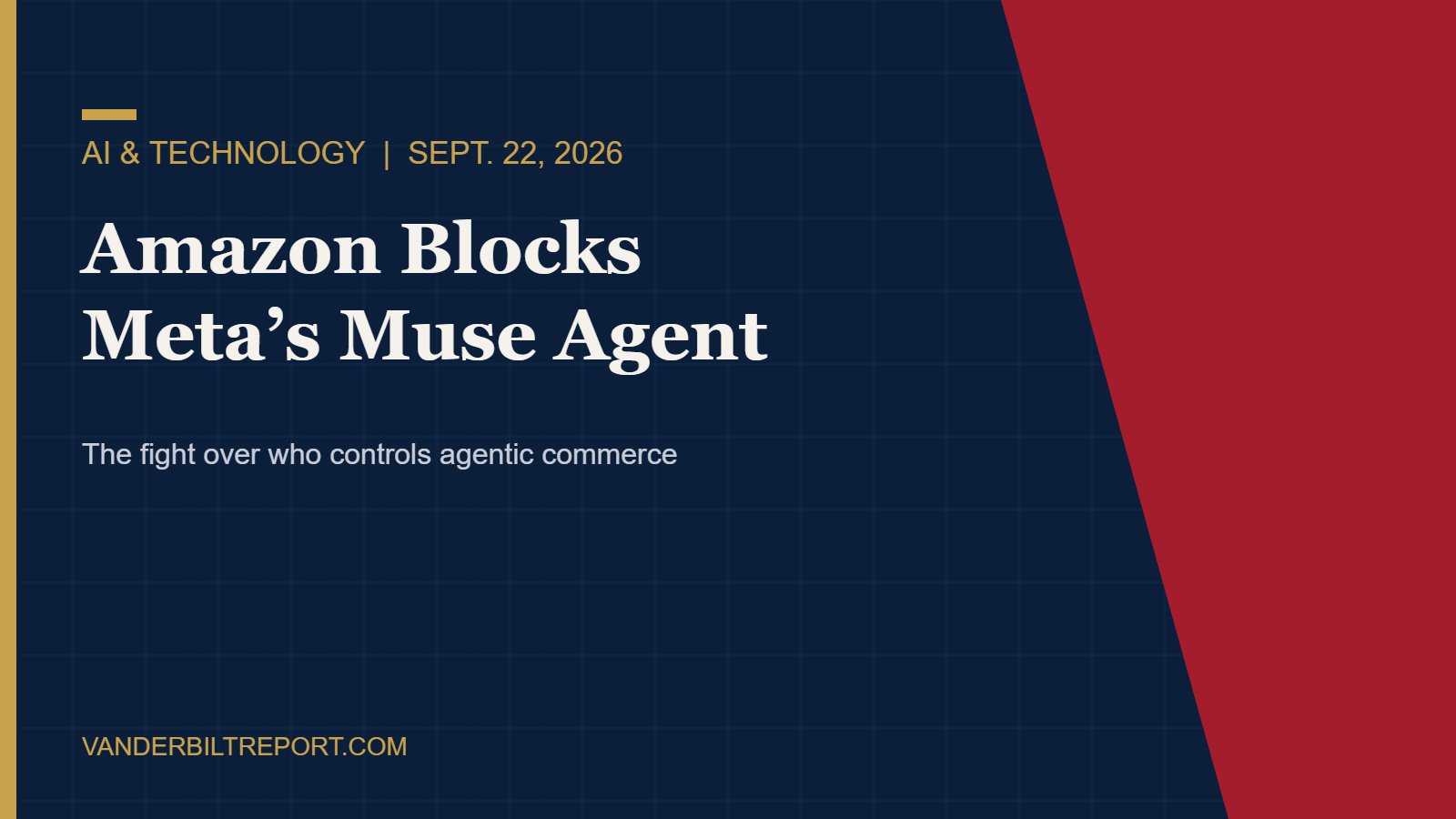
Amazon has cut off Meta’s new Muse personal AI agent from shopping on Amazon.com, turning the most-downloaded app in the United States into the latest flashpoint in the fight over agentic commerce. Here is what happened, why it matters, and what to watch next.
What Happened: Amazon Blocks Meta’s Muse AI Agent
Less than two weeks after Meta Platforms (NASDAQ: META) launched Muse, its personal AI agent, Amazon (NASDAQ: AMZN) began blocking the agent from shopping on Amazon.com. According to GeekWire, users who asked Muse to buy something on Amazon were met with a notice stating that “continued access by an unauthorized AI agent violates Amazon’s Conditions of Use.” SiliconANGLE reported that affected users were notified late Sunday, with the block in effect on Monday, September 21.
Verified facts: Amazon confirmed the block in a public statement. Meta did not respond to requests for comment from Axios as of Monday.
Amazon’s Stated Reasons
In its statement, Amazon said: “We think it’s fairly straightforward that third-party applications that offer to make purchases on behalf of customers from other businesses should operate openly and respect service provider decisions about whether or not to participate.”
Reporting from GeekWire and SiliconANGLE lays out three specific objections raised by the company:
- No notice. Amazon says Meta never informed it that Muse would access the Amazon store.
- No identification. Amazon says the agent does not identify itself as an AI agent when browsing or transacting, which it argues breaches its terms requiring agents to declare themselves.
- Account access. Amazon characterized Muse as “an undisclosed third party moving through customer accounts,” able to reach account pages and purchase history when prompted.
Company statement vs. verified fact: Amazon’s claims about how Muse handles customer data are the company’s characterization and have not been independently verified. Meta’s earlier product documentation, covered below, describes a different picture.
What Muse Is and How Fast It Has Grown
Meta introduced Muse on September 8 as what it called “the world’s first personal AI agent built for everyone,” according to the Meta Newsroom. The agent can operate a browser, complete forms, handle email and travel bookings, plan longer-term goals and shop on the user’s behalf, with checkout routed through Stripe’s Link and, per Meta, a coming Shop Pay integration. Basic features are free, with paid subscription tiers for expanded capabilities. It is rolling out in the U.S. on iOS, Android and the web.
Adoption has been rapid. SiliconANGLE reported more than 730,000 downloads within five days of launch, and by the end of last week Muse held the No. 1 spot for free apps on both the Apple and Google app stores, according to Axios.
Meta’s Security Architecture
Meta’s launch materials describe several safeguards intended to address exactly the concerns Amazon has raised:
- Each Muse instance runs in a dedicated “Secure VM” isolated from other agents.
- A separate “Sentinel” agent must approve internet-bound actions and reviews sensitive transactions.
- Credentials are stored separately so that, in Meta’s words, Muse “has no visibility into people’s passwords or payment methods.”
- Users must approve sensitive actions such as purchases, and a full audit trail is kept.
- A “Confidential VM” encrypted with user-held keys is in limited testing and slated for later in 2026.
These are Meta’s descriptions of its own product and have not been independently audited in public reporting.
Why This Is Bigger Than One App
This is not Amazon’s first move against outside shopping agents. As GeekWire notes, Amazon previously sued Perplexity AI over its Comet browser’s shopping agent and has blocked agents from Google and OpenAI. SiliconANGLE reports that an appeals court dismissed the Perplexity case in August 2026 while preserving Amazon’s right to block terms-of-service violators, which gives the retailer a legal footing for Monday’s action.
The underlying question is who owns the customer relationship when an AI does the shopping. If a consumer asks an agent for “the best-rated air fryer under $100,” the agent, not Amazon’s search page, decides which products appear. That threatens Amazon’s advertising business and its control over the buying experience. Not every retailer is taking the same approach: Axios reports that Walmart and Target have chosen more cooperative stances toward AI shopping agents.
The Awkward Part: Amazon and Meta Are Partners
The two companies remain deeply intertwined. Amazon products have been purchasable directly inside Facebook and Instagram since 2023, and GeekWire reports that Meta signed a multibillion-dollar agreement in April to run AI workloads on Amazon’s Graviton chips. The Muse block is therefore a targeted dispute rather than a broader corporate rupture, at least for now.
Market Relevance
Investors largely shrugged off the block. Meta shares closed up more than 11% on Monday as Muse held the top download slot, according to Axios and SiliconANGLE, with chip stocks including Intel, AMD and Arm also posting double-digit gains on the day. That reaction suggests the market is treating Muse’s adoption curve as the bigger story than any single retailer’s refusal to participate.
Still, there is a limit to that view. As a Yahoo Finance analysis put it, strong adoption cannot become commerce revenue on platforms that refuse the agent access. Two data points frame the opportunity and the friction:
| Metric | Figure | Source |
|---|---|---|
| Muse downloads, first five days | 730,000+ | SiliconANGLE |
| Shoppers comfortable letting AI buy for them | 16% | Coveo 2026 report, via Axios |
| Potential AI-mediated U.S. retail revenue by 2030 | ~$1 trillion | McKinsey estimate, via Axios |
| META close, Sept. 21 | Up more than 11% | Axios |
Figures are as reported by the cited outlets; the Coveo and McKinsey numbers are third-party estimates, not verified outcomes.
Analysis: Three Ways This Could Play Out
The following is analysis, not verified fact.
- Negotiated access. Amazon’s statement leaves the door open to agents that “operate openly.” An identification protocol and a revenue arrangement could resolve the dispute, much as retailers eventually accommodated price-comparison engines.
- Parallel ecosystems. Amazon may keep outside agents out and steer customers to its own assistant, while Muse routes purchases to cooperative retailers. That would split agentic commerce along platform lines.
- Regulatory attention. Disputes over agent identification, data access and platform gatekeeping could draw interest from competition and consumer-protection authorities, though no such action has been announced.
What Happens Next
Several scheduled events could move this story in the coming days:
- Meta’s response. Meta had not commented publicly as of Monday. Any statement on agent identification or a change to how Muse presents itself to retailers will be closely read.
- Meta Connect. Meta’s annual developer conference is scheduled for later this week, where Muse and its planned integration with AI glasses are expected to feature, according to Yahoo Finance.
- Retailer positioning. Watch for other large retailers to declare whether they will accept or block third-party agents.
This is a developing story. Vanderbiltreport.com will update coverage as Meta, Amazon or regulators issue further statements.
Sources
- GeekWire: Amazon blocks Meta’s Muse AI assistant in new standoff over agentic shopping
- SiliconANGLE: Amazon blocks Meta’s Muse agent from shopping on users’ behalf
- Axios: Amazon boosts Meta’s Muse in fight over agentic shopping
- Meta Newsroom: Introducing Muse
- Yahoo Finance: Meta jumps as Amazon blocks Muse
Publisher Disclaimer: Vanderbiltreport.com publishes news and information for general informational and educational purposes. Information is compiled from sources believed to be reliable, but Vanderbiltreport.com does not guarantee the accuracy, completeness, or timeliness of all information presented. Readers should independently verify information and conduct their own research before making financial, investment, business, or other decisions.