

When Markets Price Relief Before Resolution: What the Iran Ceasefire Tells Us About Geopolitical Risk
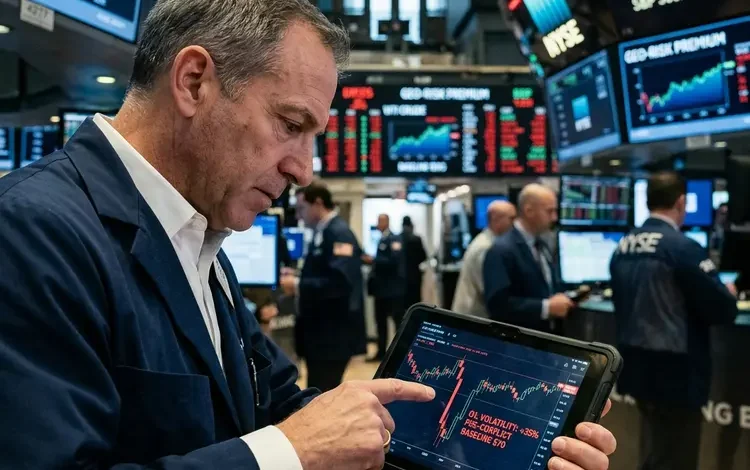

We watched the Dow spike 1,300 points in a single session. The S&P 500 climbed over 2%. Germany’s DAX posted its best day since March 2022, soaring 5.06%.
The catalyst? A ceasefire announcement in a conflict that had choked off 20% of the world’s oil supply through the Strait of Hormuz.
But here’s what the headlines missed: oil prices dropped 13-15% and still remained $25 above pre-conflict levels. Markets rallied on relief while the underlying risk premium stayed baked into energy costs.
This disconnect reveals something fundamental about how markets process geopolitical events in 2026. We’re not just watching earnings season unfold against a backdrop of easing tensions. We’re witnessing a structural shift in how investors weigh corporate fundamentals against global instability.
The Geopolitical Risk Premium That Won’t Disappear
The International Energy Agency called this the “largest supply disruption” in the history of the global oil market. That’s not hyperbole.
When the Strait of Hormuz faces closure threats, the entire energy infrastructure of the global economy shifts into crisis mode. Brent crude fell to $94.80 per barrel after the ceasefire. WTI crude dropped to $95.75. Both figures represent massive declines from their conflict peaks.
Yet both remain roughly 35% above the $70 baseline we saw before tensions escalated.
This persistent premium tells us markets haven’t priced in resolution. They’ve priced in temporary de-escalation. The Organization for Economic Cooperation and Development projects U.S. inflation will hit 4.2% in 2026, up from 2.68% throughout 2025. Energy costs drive that forecast.
American drivers felt this directly. Gas prices surged $1.18 per gallon, a 40% jump to $4.16. That translates geopolitical risk from an abstract market concept into household budget pressure.
The inflation story matters because it changes the Federal Reserve calculus. It shifts corporate cost structures. It alters consumer spending patterns right as earnings season delivers its verdict on Q1 performance.
Earnings Season Meets Elevated Volatility
Analysts forecast year-over-year earnings growth of approximately 12.5% to 13.2% for Q1 2026. If that holds, we’re looking at the sixth consecutive quarter of double-digit growth.
The problem? Forward guidance now carries more weight than the headline numbers.
JPMorgan Chase illustrated this perfectly. The bank reported adjusted earnings per share of $5.94, beating the $5.46 consensus. Total revenue hit $50.5 billion, driven by investment banking strength.
Shares dropped nearly 3% in early trading.
Why? Management trimmed 2026 Net Interest Income guidance to $103 billion from $104.5 billion. A classic “beat and retreat” scenario where strong results get overshadowed by cautious outlook.
This pattern reveals what matters in volatile environments. Markets tolerate uncertainty when growth trajectories look clear. They punish ambiguity when external risks cloud visibility.
Of the 22 companies that reported by April 13, 77% beat mean EPS estimates with an aggregate surprise of 14.3%. That’s constructive. But the real test comes in management commentary about supply chains, energy costs, and demand outlook.
Sector-Specific Volatility Tells the Real Story
Energy sector earnings estimates swung wildly. The growth forecast started the year at 0.3%. It jumped to 12.9% on April 3 as higher commodity prices flowed through to upstream earnings. By April 10, it had collapsed back to -0.1% following downward revisions.
That’s a 13-percentage-point swing in one week.
This volatility explains why forward guidance matters more than historical growth rates. Companies can report strong quarters while simultaneously lowering expectations for the rest of the year. The market reprices based on the future, not the past.
Twelve months ago, 452 S&P 500 companies cited “tariff” or “tariffs” on Q1 2025 earnings calls. Trade policy dominated corporate decision-making. For Q1 2026, geopolitical risk has taken its place as the defining theme.
That shift changes how we interpret earnings results. Strong performance in Q1 doesn’t guarantee strong performance in Q2 if energy costs remain elevated or supply chains face new disruptions.
Valuation Compression Creates Opportunity
The S&P 500 trades at 19.4x forward 12-month earnings. That’s above the 10-year average of 19.0x but below the 5-year average of 20.0x.
This valuation compression matters. When markets traded at higher multiples, positive earnings surprises had less room to expand valuations. Now, strong results combined with optimistic guidance carry greater potential to move stock prices.
J.P. Morgan Private Bank analysis shows geopolitical events typically don’t have lasting impacts on large cap equity returns. These shocks create near-term drawdowns in both stocks and sovereign bonds. Gold serves as one of the best tactical hedges against geopolitical risk.
But here’s the nuance: the lack of lasting impact assumes the geopolitical event resolves without triggering broader economic damage. A ceasefire that sticks produces different outcomes than a ceasefire that breaks down in three months.
Research shows geopolitical risk increases stock market volatility more significantly for emerging economies, crude oil exporters, and countries at peace. Different markets respond differently to the same global events.
For U.S. investors, this means looking beyond domestic earnings to understand how international exposure affects corporate performance. A company with significant European operations faces different risks than a purely domestic player.
What This Means for the Rest of 2026
We’re watching two narratives unfold simultaneously. Corporate America continues to deliver solid earnings growth. Global instability continues to inject volatility into market pricing.
The question isn’t whether earnings matter. They do. The question is whether earnings growth can overcome persistent geopolitical risk premiums.
The evidence suggests markets will reward companies that demonstrate resilience in their forward guidance.
That means several things practically:
- Companies with diversified supply chains face less risk than those dependent on single-source suppliers
- Energy-intensive businesses need clear strategies for managing input cost volatility
- International exposure requires transparent communication about regional risk management
- Pricing power becomes more valuable when inflation pressures persist
The 1,300-point Dow rally tells us markets want to price in optimism. The persistent $25 oil premium tells us markets haven’t fully bought the optimistic scenario.
This tension creates opportunity for investors who can distinguish between companies delivering sustainable growth and those benefiting from temporary relief rallies.
Earnings season provides the data. Management guidance provides the context. Geopolitical developments provide the volatility. Understanding how these three factors interact determines whether you capture returns or get caught in drawdowns.
We’re not suggesting you can predict geopolitical events. We’re suggesting you can evaluate how companies position themselves to handle uncertainty. That’s the skill that matters when relief rallies fade and fundamental performance becomes the focus again.
The Iran ceasefire created space for markets to breathe. Whether that space translates into sustained gains depends on what companies say about the rest of 2026 when they report results.
That’s the story earnings season tells this quarter. Not just what happened in Q1, but what management expects for the rest of the year in an environment where geopolitical risk remains elevated even as immediate threats recede.