

The Hormuz Blockade Just Rewrote the Rules for Energy Markets

We watched oil prices spike above $100 a barrel on Monday after President Trump ordered a US Navy blockade of the Strait of Hormuz. Brent crude hit $102.24, while WTI surged to $105—a 9.3% jump that sent shockwaves through global markets.
This isn’t just another geopolitical headline. The International Energy Agency called this the “largest supply disruption” in the history of global oil markets.
The numbers tell the story. The Strait of Hormuz handles 34% of global crude oil trade—nearly 15 million barrels per day. Asian markets take 89.2% of those flows, with China alone receiving 37.7% of all exports through this chokepoint.
The Supply Shock Is Already Here
Iraq, Saudi Arabia, Kuwait, UAE, Qatar, and Bahrain collectively shut in 7.5 million barrels per day in March. The EIA estimates that number will climb to 9.1 million barrels per day in April—a restriction of more than 90% of shipments through the strait.
Markets reacted exactly as you’d expect. Asian equities fell. The dollar strengthened. Bond yields rose. Gold dipped despite its traditional safe-haven status.
The energy sector became the top-performing sector year-to-date, gaining around 40%. Oil-focused ETFs like USO and BNO climbed in after-hours trading as investors priced in the Hormuz risk premium.
What This Means for Traditional Hedges
We’ve seen this pattern before, but never at this scale. Analysts estimate the current geopolitical risk premium adds $4-$10 per barrel to oil prices. Under worst-case scenarios, some forecasts suggest prices could approach $150 per barrel.
The EIA forecasts Brent crude will peak at $115 per barrel in Q2 2026, maintaining a risk premium throughout the forecast period due to ongoing supply uncertainty.
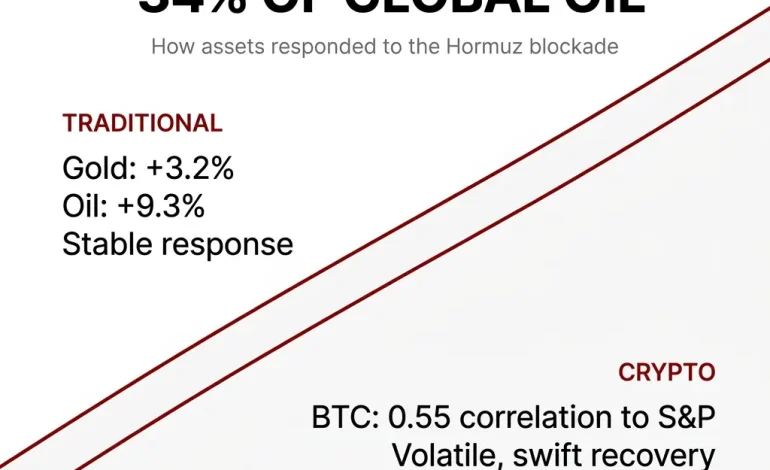
Gold gained 3.2% during initial crisis moments, demonstrating its consistent hedging characteristics. But the story gets more interesting when you look at alternative assets.
Crypto’s Mixed Performance Reveals Something Important
Bitcoin fluctuated between $84,000-$92,000 in Q1 2026. It initially dropped alongside equities during panic moments, showing a short-term correlation of around 0.55 to the S&P 500.
That correlation matters. It shows crypto doesn’t always behave like a traditional safe haven during acute crisis moments.
But Bitcoin’s recovery tends to be swift as investors search for alternative stores of value and protection against currency debasement. Research shows that while Bitcoin and Ethereum exhibit partial hedging properties under moderate geopolitical risk, their response is heterogeneous and nonlinear.
The data reveals a positive association between total cryptocurrency market capitalization and geopolitical risk during periods of political tension. Investors do move capital into crypto markets when traditional systems show vulnerability.
Cryptocurrencies demonstrate relatively weaker hedging functions compared to gold, USD, and oil in the short term. But they offer something those assets don’t—decentralization from state-controlled financial infrastructure.
The Fragility We’re Learning to Price In
The Hormuz blockade exposed how vulnerable global supply chains remain to single-point failures. One chokepoint. One executive order. Markets moved billions in hours.
We’re watching investors recalibrate their understanding of geopolitical risk in real time. The traditional playbook—dollar strength, bond yields, gold—still works. But the search for alternatives that exist outside traditional financial systems accelerated.
This crisis won’t be the last test of how markets respond to supply disruption and currency debasement fears. The question isn’t whether crypto will replace traditional hedges. The question is how investors will allocate across both systems as geopolitical fragmentation continues.
The energy sector’s 40% gain shows where money flows when physical commodities become scarce. Crypto’s mixed performance shows we’re still learning how digital assets fit into crisis portfolios.
But one thing became clear this week: diversification across asset classes and systems matters more than ever when a single strait can move global markets this fast.