Key takeaways
- A reverse stock split combines existing shares into fewer, higher-priced shares. On the day it takes effect, it does not by itself change a company’s market value or an investor’s percentage ownership.
- The most common reason U.S.-listed companies do one is to stay above the $1.00 minimum bid price required by Nasdaq and the NYSE.
- Exchange rules adopted in 2024–2025 limit how often a company can rely on reverse splits to fix a low share price, and Nasdaq can now move faster to delist stocks that trade at $0.10 or less.
- Shareholders should watch the split ratio, how fractional shares are handled, what happens to options and warrants, and whether the company is also raising new capital.
A reverse stock split is one of the most common corporate actions among small-cap and microcap companies, and one of the most misunderstood. It can look like a sudden price jump in a brokerage account, or like a big drop in the number of shares an investor holds. In practice, it is mostly arithmetic. What matters for shareholders is why the company is doing it, and what tends to come with it.
This guide explains how reverse splits work, the stock exchange rules that drive most of them, how they affect fractional shares and options, and the questions investors can ask when a company announces one.
What is a reverse stock split?
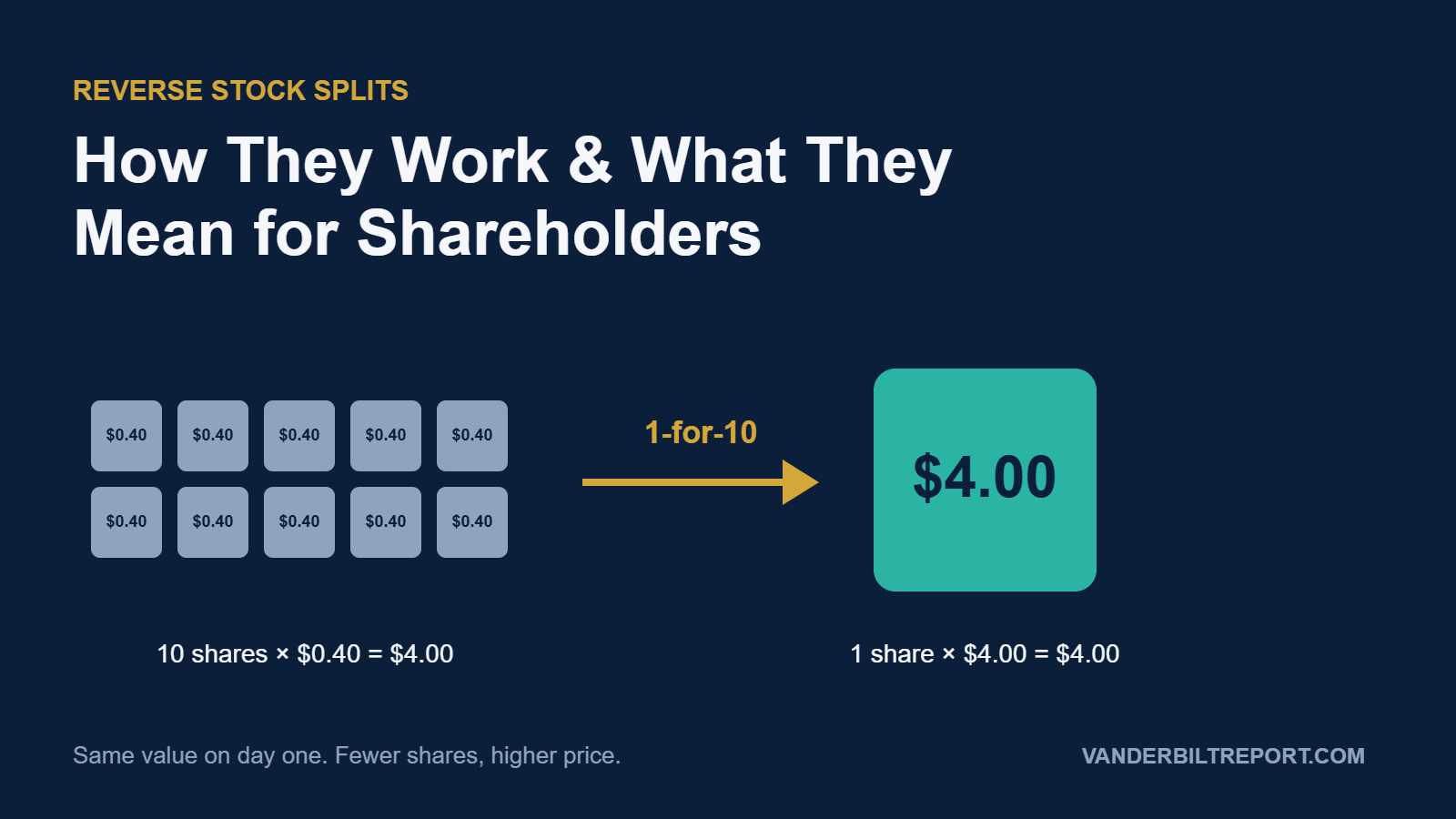
In a reverse stock split, a company converts a set number of existing shares into one new share. The SEC’s investor education site, Investor.gov, gives a simple example: in a 1-for-10 reverse split, every ten shares an investor owns become one share, so a holder of 10,000 shares ends up with 1,000.
The share price adjusts in the opposite direction. If the stock closed at $0.40 before a 1-for-10 split, the starting reference price afterward is about $4.00. The investor’s position is worth the same on paper at the moment the split takes effect.
Reverse split vs. forward split
| Forward stock split | Reverse stock split | |
|---|---|---|
| Example ratio | 2-for-1, 10-for-1 | 1-for-10, 1-for-50 |
| Shares outstanding | Increase | Decrease |
| Price per share | Falls proportionally | Rises proportionally |
| Market value on effective date | Unchanged by the split itself | Unchanged by the split itself |
| Typical context | Share price has risen a lot; company wants a lower per-share price | Share price has fallen; company needs to meet a listing standard or wants a higher per-share price |
How the math works
The ratio determines everything. Here is how a hypothetical 1-for-10 reverse split would change the basic numbers:
| Metric (hypothetical company) | Before 1-for-10 split | After 1-for-10 split |
|---|---|---|
| Shares outstanding | 200,000,000 | 20,000,000 |
| Share price | $0.40 | $4.00 (reference) |
| Market capitalization | $80 million | $80 million |
| An investor’s shares | 10,000 | 1,000 |
| Value of that position | $4,000 | $4,000 |
| Investor’s ownership percentage | 0.005% | 0.005% |
Earnings per share and book value per share also rise by the same factor, because the same totals are divided by fewer shares. Historical per-share figures in financial statements are usually restated so that periods can be compared.
After the effective date, of course, the price is set by trading, not arithmetic. The split does not change the company’s revenue, cash, debt or business prospects.
Why companies do reverse splits
1. Keeping a stock exchange listing
This is the most common reason. Both major U.S. exchanges have a $1.00 minimum price standard:
- Nasdaq: Under Nasdaq Rule 5810(c)(3)(A), a company falls out of compliance when its stock closes below $1.00 for 30 consecutive business days. It then generally has 180 calendar days to regain compliance, usually by closing at or above $1.00 for at least 10 consecutive business days. Companies on the Nasdaq Capital Market may be eligible for a second 180-day period if they meet the other initial listing standards (summary of the Nasdaq timeline).
- NYSE: Section 802.01C of the NYSE Listed Company Manual requires an average closing price of at least $1.00 over 30 consecutive trading days, with a six-month cure period in most cases (Hogan Lovells summary).
If the stock cannot recover on its own, a reverse split is often the fastest way to lift the price above $1.00 before the deadline.
2. Institutional and broker access
Some institutional investors and funds have internal policies against buying very low-priced stocks, and some brokers apply stricter margin rules to them. Companies sometimes cite a higher share price as a way to widen their potential investor base. These are company statements of intent; whether they lead to broader ownership varies.
3. Before an uplisting or a transaction
A company trading over the counter that wants to move up to Nasdaq or NYSE American usually has to meet a minimum bid price for initial listing. A reverse split is often part of that plan. Reverse splits also appear ahead of mergers, recapitalizations and some capital raises. For background on the OTC tiers that many of these companies start from, see our guide to OTC market tiers: OTCQX, OTCQB, OTCID and Pink.
The newer exchange rules on repeated reverse splits
Exchanges and regulators have been concerned about companies that do reverse split after reverse split while the business keeps shrinking. Since late 2024, several rule changes have tightened the process. The table below summarizes them as reported by law firm summaries of the SEC-approved rules.
| Rule change | Nasdaq | NYSE |
|---|---|---|
| Reverse split within the prior year | No compliance period if the stock falls below $1.00 again within one year of a reverse split; delisting determination issued immediately | No compliance period if the company effected a reverse split in the past year |
| Cumulative ratio over two years | No compliance period if reverse splits over the prior two years total 250-to-1 or more | No compliance period if reverse splits over the prior two years total 200-to-1 or more |
| Split that breaks another standard | A reverse split that pushes the company below another listing standard (for example, publicly held shares or round-lot holders) does not cure the deficiency | Companies may not effect a reverse split that causes non-compliance with other listing standards |
| Very low prices | Delisting determination if the stock closes at $0.10 or less for 10 consecutive business days (approved December 2025) | Separate “abnormally low” price standards apply |
| Trading after compliance periods expire | Securities are suspended while a hearing appeal is pending after a company exhausts 360 days of compliance periods | Delisting procedures under the Listed Company Manual |
Sources: Hogan Lovells; Federal Register, NYSE rule approval (Jan. 22, 2025); Federal Register, Nasdaq $0.10 rule approval (Dec. 10, 2025); Securities Law Blog tally of Nasdaq rule changes (July 2026). Exchange rules can change; the exchanges’ own rulebooks are the controlling text.
Why this matters for investors: Under these rules, a company that has recently completed a large reverse split may have much less time to fix a new price problem. That is useful context when reading a company’s disclosures about its listing status.
The approval and announcement process
Shareholder and board approval
Whether shareholders must vote depends on the state where the company is incorporated and its charter. Delaware, where many U.S. public companies are incorporated, amended Section 242 of its corporation law in 2023. For a company whose shares are listed on a national exchange and that will still meet listing requirements afterward, a reverse split can be approved when the votes cast for it exceed the votes cast against it, rather than requiring a majority of all outstanding shares. Abstentions do not count against it (ABA Business Law Today). Companies often ask shareholders to approve a range of ratios and let the board pick the final ratio later.
Notice to the market
- Nasdaq companies must submit a Company Event Notification Form by 12:00 p.m. ET at least 10 calendar days before the market effective date, up from five business days previously, and must publicly disclose the split at least two business days before it takes effect (Nasdaq Rules 5250(e)(7) and 5250(b)(4)).
- OTC companies generally must notify FINRA under FINRA Rule 6490 and SEC Rule 10b-17 at least 10 calendar days before the record date. FINRA can decline to process a corporate action in certain circumstances, and processed actions appear on FINRA’s Daily List.
- Reporting companies typically file a Form 8-K describing the charter amendment and the effective date. Most reverse splits also come with a new CUSIP number.
Tip: If you want to see how a company describes its share count and listing risks in its annual filing, our guide on how to read a 10-K walks through where to look.
What happens to your shares, fractional shares and options
Your share count and cost basis
Your broker will adjust your position automatically, usually on the market effective date. Your total cost basis generally stays the same, but the per-share basis rises by the split factor. For example, 10,000 shares bought for a total of $5,000 ($0.50 each) become 1,000 shares with a per-share basis of $5.00. Readers should confirm tax treatment with a tax professional, especially where cash is paid for fractional shares.
Fractional shares
If your holding does not divide evenly by the ratio, you will be left with a fraction. Companies handle this in different ways:
- Cash in lieu: the company or transfer agent pays cash for the fractional share, which Investor.gov notes can effectively cash out very small holders.
- Rounding up: some companies round fractional shares up to one whole share.
- Rounding down: less common, but possible depending on the terms.
The method is disclosed in the proxy statement or the company’s announcement.
Listed options
According to the Options Industry Council, the Options Clearing Corporation (OCC) adjusts listed options so their exercise value is preserved. In a 1-for-10 reverse split, a contract that delivered 100 shares typically becomes a contract that delivers 10 shares. The strike price and the number of contracts usually stay the same. Ratios that create fractional shares (such as 1-for-7) can lead to cash components in the deliverable. These adjusted, non-standard options can be less liquid, so holders should read the OCC Information Memo for the specific security.
Warrants and convertible securities
Warrants, convertible notes and preferred stock usually carry anti-dilution or adjustment provisions. After a reverse split, their exercise or conversion prices typically rise and the number of underlying shares falls in proportion. Terms vary, so check the original agreements, which are often exhibits to SEC filings.
What a reverse split can signal and what it doesn’t
A reverse split is a mechanical change. It does not make a business more or less valuable. But the circumstances around it are often informative. Research and market commentary have long noted that reverse splits are frequently associated with companies under financial pressure, and that post-split price performance varies widely. Past patterns do not predict how any particular stock will trade.
Context that investors often look at:
- Frequency: Is this the company’s first reverse split or its third in a few years?
- Accompanying financing: Is a stock offering, warrant issue or convertible financing expected at the same time or soon after? New shares issued after a split can dilute existing holders.
- Authorized shares: Does the number of authorized shares shrink in proportion, or does it stay the same? If it stays the same while outstanding shares fall, the company has more room to issue new shares later.
- Cash runway: How many months of cash does the company say it has, and does its auditor’s report include a going-concern paragraph?
- Listing position: Has the company received a deficiency notice, and how much time does it have under the current rules?
- Stated purpose: Is the split tied to a specific goal, such as an uplisting or a merger, and is that goal disclosed with details?
A shareholder checklist for reverse split announcements
| Question | Where to find the answer |
|---|---|
| What is the ratio and the effective date? | Press release, Form 8-K |
| Why is the company doing it? | Proxy statement (DEF 14A) or information statement (DEF 14C) |
| How will fractional shares be treated? | Proxy or information statement |
| Will authorized shares change? | Proxy statement; charter amendment exhibit |
| Has the company received an exchange deficiency notice? | Form 8-K (Item 3.01) |
| Are there prior reverse splits? | 10-K, prior 8-Ks, share-count history |
| Is a financing planned? | Recent S-1/S-3 filings, 8-Ks, 10-Q liquidity discussion |
| How are options and warrants adjusted? | OCC Information Memo; warrant agreements |
All of these filings are free on the SEC’s EDGAR full-text search. For more on low-priced securities, see our Stocks Under A Dollar coverage.
Frequently asked questions
Do I lose money in a reverse stock split?
Not from the split itself. On the effective date, your position’s value is the same, just spread over fewer shares. Afterward, the price moves with trading, and it can rise or fall. Small holders may receive cash for fractional shares.
Do I need to do anything when a company I own does a reverse split?
Usually not. Brokers adjust positions automatically. If you hold physical certificates or shares directly with the transfer agent, the company will explain any exchange process.
Why did my stock’s ticker or CUSIP change?
A new CUSIP is standard after a reverse split. Some companies also change their ticker temporarily or permanently. On OTC markets, FINRA may flag the symbol while the corporate action is processed.
Can a company do a reverse split without a shareholder vote?
It depends on state law and the company’s charter. In many cases a vote is required; some states allow boards to act alone in certain situations. The company’s filings will state what approval was obtained.
Does a reverse split guarantee a company keeps its listing?
No. The share price must stay above the minimum after the split, and the company must meet all other listing standards. Under the newer rules, a company that falls below $1.00 again within a year of a reverse split may not get another compliance period.
Bottom line
A reverse stock split changes the number of shares and the price per share, not the underlying business. For investors, the useful questions are about context: why the company is doing it, how often it has done it before, what financing or dilution may follow, and how much room it has under exchange rules that have become noticeably stricter since 2024. Reading the proxy statement and the 8-K usually answers most of them.
This article explains general concepts and publicly available rules as of September 2026. It is not investment, legal or tax advice. Exchange and state rules are summarized from the sources linked above and may change.
Publisher Disclaimer: Vanderbiltreport.com publishes news and information for general informational and educational purposes. Information is compiled from sources believed to be reliable, but Vanderbiltreport.com does not guarantee the accuracy, completeness, or timeliness of all information presented. Readers should independently verify information and conduct their own research before making financial, investment, business, or other decisions.