
Investor education from the Vanderbiltreport Team. Statements labelled Verified come directly from published rulebooks and regulator materials linked in the text; passages labelled Analysis are our explanatory commentary. Nothing here is an investment recommendation.
Thousands of companies trade in the United States without ever listing on the NYSE or Nasdaq. They trade “over the counter,” and the label attached to each one matters more than many investors realize. Understanding OTC market tiers is the quickest way to judge how much information a company is required to share, how easily its shares can be quoted, and what warning signs may already be attached to the ticker.
This guide explains the four tiers run by OTC Markets Group — OTCQX, OTCQB, OTCID and Pink Limited — plus the Expert Market and Grey Market that sit beneath them.
What “Over the Counter” Actually Means
Verified: The U.S. Securities and Exchange Commission defines OTC securities simply as securities not listed on a national securities exchange. Instead of a central exchange, broker-dealers publish bid and ask quotes on interdealer quotation systems such as OTC Link ATS, which is operated by OTC Markets Group.
Verified: The SEC also cautions that many OTC issuers do not file periodic reports or audited financial statements with the agency, which can make reliable information hard to find.
Analysis: That information gap is exactly what the tier system is meant to address. A tier is not a rating of the business. It is a signal of how much disclosure and verification stands behind the ticker.
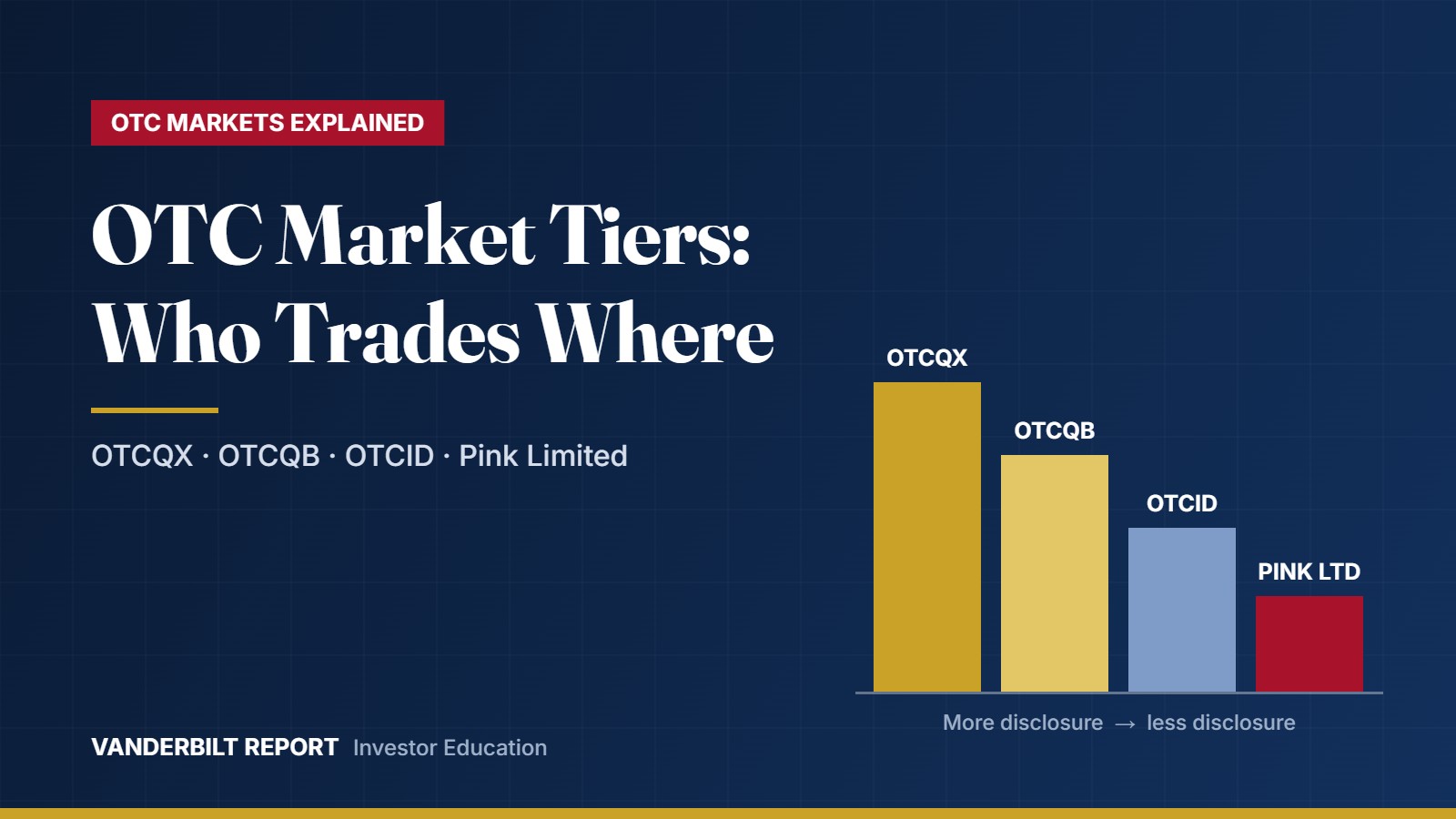
OTC Market Tiers at a Glance
| Tier | Nickname | Minimum bid price to join | Core disclosure standard | Publicly quoted? |
|---|---|---|---|---|
| OTCQX | Best Market | $0.25 ($1.00 for banks) | Current reporting, financial tests, governance standards | Yes |
| OTCQB | Venture Market | $0.05 | Current reporting, audited annual financials, annual certification | Yes |
| OTCID | Basic Market | None | Current reporting, verified profile, management certification | Yes |
| Pink Limited | Limited information | None | Falls short of OTCID requirements | Restricted (unsolicited-only) |
| Expert Market | — | None | Typically delinquent or non-compliant with Rule 15c2-11 | Not shown to retail investors |
| Grey Market | — | None | No broker-dealer quotations | No |
OTCQX: The Best Market
Verified: Under the OTCQX Rules for U.S. Companies, a company applying to the top tier must show:
- A minimum bid price of $0.25 per share ($1.00 for banks) on each of the 30 calendar days before admission.
- Market capitalization of at least $25 million over the same period.
- Either net tangible assets of $2 million (three or more years of operations) or $5 million (less than three years), or average revenue of at least $6 million over the last three years.
- At least 100 beneficial shareholders each holding 100 shares or more, and a public float worth at least $5 million.
- At least two independent directors, an audit committee with a majority of independent members, and annual shareholder meetings.
Verified: To stay on OTCQX, the rules require a bid of at least $0.10 and a market capitalization of at least $10 million on at least one of every 30 consecutive calendar days.
Analysis: OTCQX is where you will often find large international companies that are listed on a foreign exchange and want U.S. trading access without a full U.S. listing, alongside established U.S. community banks and operating companies.
OTCQB: The Venture Market
Verified: The OTCQB Rules are designed for earlier-stage and developing companies. Key requirements include:
- A minimum bid price of $0.05 per share on each of the 30 calendar days before admission.
- At least 50 beneficial shareholders each owning 100 shares or more.
- A public float of at least 10% of the share class outstanding.
- Audited annual financial statements with an opinion that is not adverse, disclaimed or qualified, from a PCAOB-registered auditor.
- A management certification published through OTC Markets’ issuer portal, and no bankruptcy or reorganization proceedings.
Verified: Once admitted, a company must keep a closing bid of at least $0.01 on at least one of every 30 consecutive calendar days. If it fails, the rules provide a 90-calendar-day cure period; a close below $0.001 for five consecutive trading days triggers immediate removal.
Analysis: For readers who follow stocks under a dollar, this matters. A sub-penny share price is not just a chart problem — it can cost a company its tier, and with it a good deal of visibility.
OTCID: The Basic Market That Replaced Pink Current
Verified: On July 1, 2025, OTC Markets Group retired the old “Pink Current” category and launched the OTCID Basic Market. According to the company’s launch announcement, 1,237 U.S. and international securities qualified at launch.
Verified: The OTCID Rules set no minimum bid price. Instead they focus on baseline transparency:
- Current disclosure under a recognized standard (SEC reporting, Regulation A, Regulation Crowdfunding, international reporting, bank reporting or OTC Markets’ Alternative Reporting Standard).
- A company profile verified through the issuer portal at least every six months.
- A management certification filed with the annual report (international reporting companies are exempt).
- For U.S. and Canadian companies, share data supplied through a transfer agent in the Transfer Agent Verified Shares Program.
Analysis: OTCID tells you the company is engaged and current. It does not tell you the financial statements were audited, and it does not impose governance or size tests. Treat it as a floor, not a seal of approval.
Pink Limited, the Expert Market and the Grey Market
Verified: OTC Markets Group describes Pink Limited as a tier for companies with limited, outdated or inconsistent disclosure and little issuer involvement. Its tier chart shows Pink Limited and Expert Market securities as eligible for unsolicited quotes only, while Grey Market securities have no broker-dealer quotes at all. Companies that lose eligibility for a tier generally receive a 15-calendar-day grace period before moving to the Expert Market.
Verified: These categories are tied to SEC Rule 15c2-11. In 2020 the SEC amended the rule to restrict broker-dealers from publishing quotes for companies that do not make current information publicly available. The agency acknowledged that affected shareholders could face lower liquidity and share values.
Analysis: In practice, a move to the Expert Market can make shares very difficult for an ordinary investor to sell. Many retail brokerages will not display quotes or will accept only closing orders. Policies differ by broker, so check with yours.
How to Check a Company’s Tier
- Search the ticker on otcmarkets.com. The tier badge appears beside the company name.
- Look for warning flags such as “Caveat Emptor,” “Shell” or delinquent-filing notices.
- Open the Disclosure tab and check the date of the most recent annual and quarterly reports.
- For SEC-reporting companies, confirm the filings on the SEC’s EDGAR database.
- Compare the share count in the latest filing with the verified share data shown on the profile.
What the Tiers Do Not Tell You
- They are not investment ratings. A tier measures disclosure and eligibility standards, not business quality or valuation.
- They are not permanent. Companies move up and down as filings go current or lapse and as share prices change.
- They do not remove penny-stock risk. Many OTC securities meet the SEC’s definition of a penny stock, which generally covers shares trading below $5, and can be thinly traded and volatile.
- They are not an exchange listing. Exchange-listed companies face separate, generally stricter, listing standards. See our NYSE-NASDAQ coverage for comparison.
Frequently Asked Questions
Is OTCQB better than OTCID?
OTCQB has stricter requirements, including a minimum bid price, audited annual financials and shareholder and float tests. OTCID requires current disclosure and verification but has no bid price or universal audit requirement.
What happened to the Pink market?
The former Pink Current category was replaced by OTCID on July 1, 2025. Companies that do not meet OTCID standards may be placed in Pink Limited.
Can I buy Expert Market stocks?
Quotes in Expert Market securities are restricted and generally not shown to retail investors. Whether any trading is possible depends on your broker’s policy.
Do OTC companies file with the SEC?
Some do and some do not. Many OTCQX, OTCQB and OTCID companies are SEC-reporting, while others use alternative or international reporting standards. Always check which standard applies.
The Bottom Line
The OTC market tiers are a disclosure ladder. The higher the tier, the more a company has had to show — and keep showing — to stay there. Checking the tier takes less than a minute and is a sensible first step before reading anything else about an OTC company. For company-specific coverage, browse our OTC section.
Sources
- SEC / Investor.gov — Over-the-Counter (OTC) Securities
- SEC — Amendments to Rule 15c2-11 (press release 2020-212)
- OTC Markets Group — OTCQX Rules for U.S. Companies
- OTC Markets Group — OTCQB Rules
- OTC Markets Group — OTCID Rules
- OTC Markets Group — Rule 15c2-11 tier chart
- OTC Markets Group — OTCID launch announcement (July 2, 2025)
Publisher Disclaimer: Vanderbiltreport.com publishes news and information for general informational and educational purposes. Information is compiled from sources believed to be reliable, but Vanderbiltreport.com does not guarantee the accuracy, completeness, or timeliness of all information presented. Readers should independently verify information and conduct their own research before making financial, investment, business, or other decisions.