

South Korea Crypto Tax Delayed Again: Government Seeks to Push 22% Levy to 2029

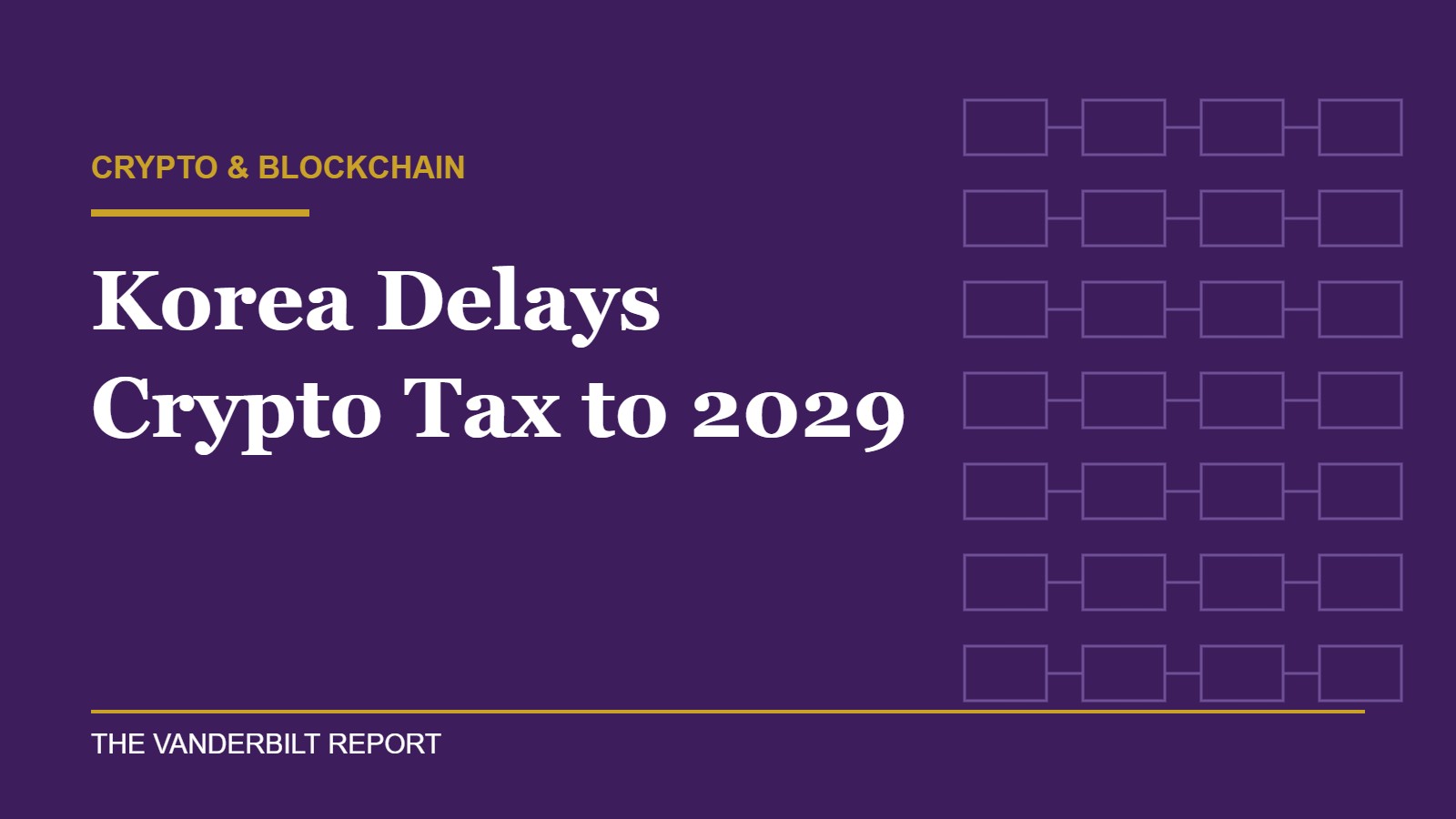
The South Korea crypto tax is being pushed back again. On Thursday, Nov. 5, 2026, Finance Minister Lee Hyoung-il announced that the government will seek to delay its planned 22% tax on cryptocurrency gains by two years, from 2027 to 2029, according to Yonhap News Agency. If the National Assembly approves it, it would be the fourth postponement since Seoul first moved to tax virtual-asset gains in 2020.
“It is with a heavy heart that I announce another proposed delay in taxation, after its implementation has already been postponed three times,” Lee said at a press conference in Seoul, per Yonhap.
South Korea Crypto Tax Delay: What Was Announced
Verified facts (Ministry of Finance and Economy statements, as reported by Yonhap):
- New target: Taxation would begin in 2029 instead of 2027. “The government will use the two-year period to ensure that taxation of virtual assets can be implemented smoothly in 2029,” Lee said.
- Rate unchanged: A 22% tax, including local income tax, would apply to the portion of annual crypto gains above 2.5 million won (about $1,869).
- Loss carryforward: The government will seek to let investors carry forward losses for up to three years to offset future gains, citing practices in the U.S. and Britain.
- Working group: A public-private working group will refine the tax system, develop detailed rules for different kinds of transactions and simplify filing. The ministry said it will hold its first meeting soon and continue through the first half of 2027.
- Legislation: The ministry plans to submit legislative amendments during the National Assembly’s regular session in 2027 and said it will “work closely with the National Assembly on the necessary legislation.”
- Digital asset law: The finance ministry will work with the Financial Services Commission to speed up enactment of a digital asset law aimed at market growth and user protection.
Why Seoul Is Delaying: U.S. Data Sharing in 2029
The government’s core rationale is timing. South Korea is set to begin exchanging information on virtual assets with the United States in 2029, and officials said introducing the tax before then could put the domestic crypto market at a disadvantage, according to Yonhap. Without overseas transaction data, investors trading on foreign platforms could be harder to tax than those using domestic exchanges.
The ministry framed the delay as a fairness measure: it “aims to uphold the basic principle that income should be taxed while improving the effectiveness of taxation on domestic and overseas transactions, ensuring greater fairness among taxpayers, and establishing a reliable and stable framework for taxation.”
Context: The information exchange relates to the OECD’s Crypto-Asset Reporting Framework (CARF), a global standard for tax authorities to share data on crypto transactions. According to crypto.news, South Korea is scheduled to begin CARF exchanges in 2027, while the United States is expected to participate from 2029.
A Timeline of Delays
| Year | Development |
|---|---|
| 2020 | South Korea moves to tax virtual-asset gains, with implementation set for January 2022 |
| Subsequent years | Start date pushed to 2023, then 2025, then January 2027 (three postponements) |
| Oct. 2026 | Ruling Democratic Party lawmaker Park Min-gyu files a bill tying the start date to CARF data exchanges (per crypto.news) |
| Nov. 3, 2026 | Ruling-party members of the National Assembly’s finance committee back a roughly two-year delay (per crypto.news) |
| Nov. 5, 2026 | Finance Minister Lee Hyoung-il announces the government will seek a delay to 2029 |
| 2027 | Working group discussions through the first half; amendments planned for the regular legislative session |
Crypto Tax Basics for Newcomers
Under the planned scheme, the tax applies only to annual gains above the 2.5 million won deduction. As a simple illustration of the stated rules, an investor with 5 million won in net annual crypto gains would owe 22% on the 2.5 million won above the threshold, or 550,000 won. Under the current framework, losses can offset gains within the same tax year but cannot be carried forward, according to crypto.news; the government’s proposal would change that by allowing a three-year carryforward.
Who Is Affected
- Korean retail investors: South Korea has one of the world’s most active retail crypto markets. Investors would not face the new tax before 2029 if the delay passes.
- Domestic exchanges: Platforms such as Upbit and Bithumb would have more time to build reporting systems. Bithumb previously told lawmakers that developing and testing its reporting infrastructure could take six to nine months after authorities provide a testing environment, according to crypto.news.
- Tax authorities: The National Tax Service gains time to secure overseas data and set rules for complex transactions.
What Happens Next
- Parliamentary approval required (developing): The current law still sets Jan. 1, 2027 as the start date. The delay requires an amendment passed by the National Assembly, where the ruling Democratic Party’s lawmakers have already backed a two-year delay.
- Working group: First meeting expected soon, with discussions through mid-2027.
- Digital asset law: The government says it will accelerate broader crypto market legislation alongside the tax overhaul.
Analysis: Repeated delays have created uncertainty for Korean investors and exchanges for six years. Tying the new start date to U.S. data sharing gives the government a concrete rationale, but whether 2029 holds will depend on the National Assembly and on international reporting arrangements arriving on schedule.
Related Coverage on Vanderbiltreport.com
- Australia Crypto Exchange Rules: ASIC Opens Consultation on Custody, Trading and Capital Standards
- OCC GENIUS Act Final Rule: Federal Stablecoin Standards Set Ahead of January 2027
- Samsung Wallet USDC: Stablecoin Transfers Come to 82 Million U.S. Galaxy Devices
- DTCC Tokenization Service Goes Live
Sources
- Yonhap News Agency, “(LEAD) S. Korea to seek 2-year delay in tax on cryptocurrency gains,” Nov. 5, 2026.
- crypto.news, “Here’s why South Korea is delaying crypto tax until 2029,” Nov. 5, 2026.
- crypto.news, “South Korea lawmakers push for another crypto tax delay until 2029,” Nov. 3, 2026.
Publisher Disclaimer: Vanderbiltreport.com publishes news and information for general informational and educational purposes. Information is compiled from sources believed to be reliable, but Vanderbiltreport.com does not guarantee the accuracy, completeness, or timeliness of all information presented. Readers should independently verify information and conduct their own research before making financial, investment, business, or other decisions.