

Vanderbilt Report: SecureTech’s AI UltraProd Lands Its First U.S. Build Site, Taking Robotic 3D-Printed Housing to California
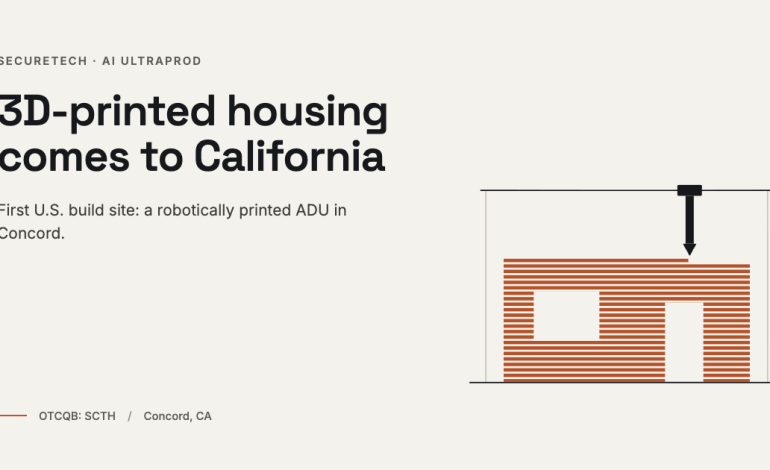

Eleven months after naming ADUs its U.S. beachhead, SecureTech has a site, a partner with skin in the game, and a two-stage plan in Concord
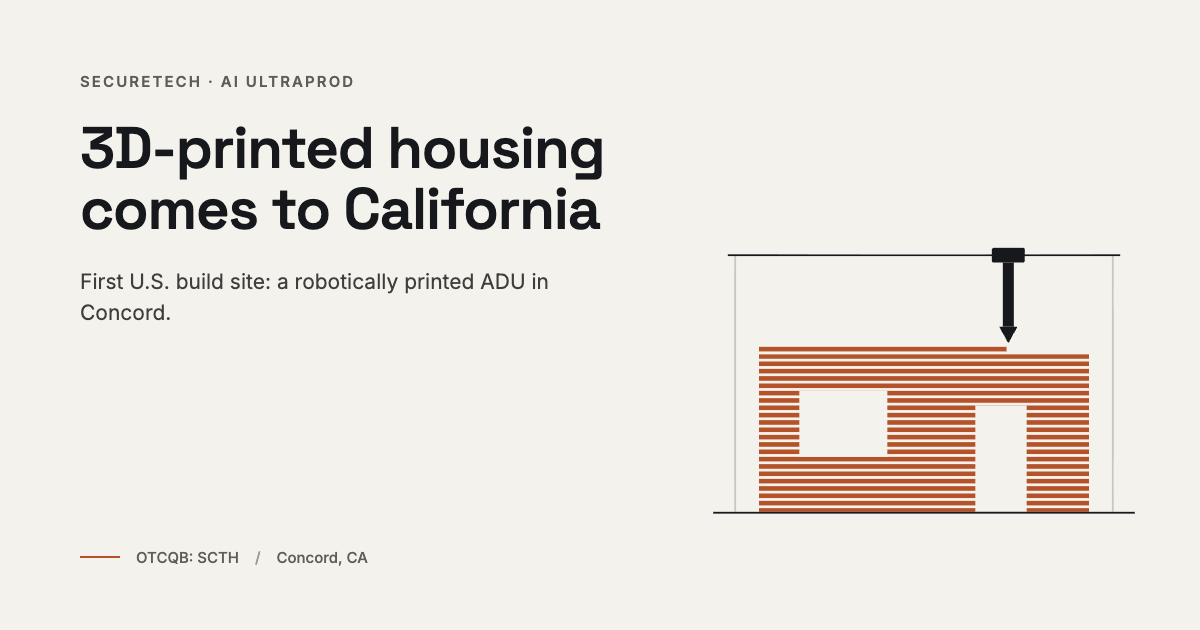
Bristol, TN — The Vanderbilt Report today published coverage of SecureTech Innovations, Inc. (OTCQB: SCTH), whose wholly owned subsidiary AI UltraProd, Inc. (AIUP) has signed a letter of intent to co-develop a 3D-printed residential project in Concord, California. It is the company’s first U.S. build site, and the first physical proof point for a U.S. strategy SecureTech laid out last December.
The idea is straightforward. Instead of framing and sheathing walls by hand, a robotic printer lays down load-bearing walls on site, layer by layer, from a structural mortar. AIUP has been selling that technology and the structures it produces in markets abroad. Concord is where American homeowners, developers and general contractors get to see it, walk through it and judge it for themselves.
A Promise Made in December, a Site in November
In December 2025, SecureTech named accessory dwelling units (ADUs) as AIUP’s U.S. “beachhead” and said it was advancing plans for a “lighthouse project”: a compact, high-visibility build to showcase the platform in a live American setting. The Concord LOI is that project taking shape.
The choice of market is deliberate. California has spent the past decade removing barriers to ADU construction, and permitting has responded. According to the state Department of Housing and Community Development, annual ADU permits grew from 1,336 in 2016 to 30,354 in 2024, a roughly 20-fold increase.
ADUs are also a natural fit for printed construction. They are small, repeatable, and built on lots where speed and a short on-site footprint matter to homeowners. A single successful unit can be shown, photographed and replicated.
How the Concord Project Is Structured
The build is planned in two stages:
- Stage One: a single-story detached ADU of approximately 748 square feet, serving as the initial demonstration build.
- Stage Two: a two-story ADU that builds on the Stage One design, combining 3D-printed load-bearing walls with conventional wood floor and roof framing.
AIUP would print the exterior load-bearing walls on site with its GEO RC1 2700 robotic printing platform and proprietary GEOMIX structural mortar. Everything else is familiar to any California builder: wood roof trusses and floor framing, standard doors and windows, and conventional mechanical, electrical and plumbing systems. That hybrid approach matters. It lets inspectors, lenders and trades evaluate one new element, the printed wall, rather than an entirely unfamiliar building.
Partners, Not Just Contractor and Client
The deal structure is as notable as the build itself. Rather than a standard construction contract, the LOI contemplates a co-development arrangement. AIUP would fund a portion of construction, design and permitting costs, including converting the owner’s existing design and permits to work with AIUP’s system. The owner would contribute the site and fund the balance. In return, AIUP would receive an ownership interest in a jointly owned project entity.
That gives AIUP an equity stake in the outcome, and it gives the property owner a technology partner with capital at risk alongside them.
“We brought the Concord property forward because we saw an opportunity to explore a different approach to residential development with a technology partner willing to invest alongside us,” said Mikial Nijor of Middle Housing Group of San Francisco. “If successful, the project could help guide how my group approaches future developments and encourage other developers to explore AiUP’s construction technology.”
The Path From LOI to Groundbreaking
Next steps are clearly defined: due diligence, design development, project-specific structural engineering by a licensed California structural engineer, and a full-scale mock-up to test the printed wall connections. The project will then seek approval from local building authorities through California’s alternative materials and design pathway, the route the state provides for construction methods outside the conventional code.
“We’re starting with a single-story ADU to validate our printed wall system, navigate the California approval process, and give homeowners, developers, and general contractors a finished structure they can see, touch, and walk through,” said J. Scott Sitra, SecureTech’s President and CEO. “If the project performs as we expect, we believe it can serve as a model for additional future projects with this owner and with other prospective partners in the U.S.”
An Operating Business Behind the Build
Concord is not a concept company’s first product. AIUP already generates revenue. SecureTech reported record second-quarter 2026 revenue of $2.77 million, up 33% sequentially, bringing first-half 2026 revenue to $4.85 million, all from AI UltraProd. Gross margin improved to roughly 32% in the quarter, up from 8.9% in Q1, on higher-margin service revenue. For full-year 2025, SecureTech reported revenue of $7.72 million and its first annual profit.
In August 2026, SecureTech decided to retain AIUP permanently as a wholly owned subsidiary, managed from its Roseville, Minnesota headquarters, rather than spin it off. The Concord LOI is the first U.S. project to come out of that decision, and it fits a company that has spent the past year building out its governance and reporting as an OTCQB issuer positioned for a move to a national exchange.
The Bottom Line
SecureTech said it would bring AI UltraProd to the United States through ADUs and a lighthouse project. It now has a site, a partner putting up land and capital, a defined engineering and approval path, and a structure that gives AIUP equity in the result. A finished, walkable printed home in the most active ADU market in the country would give the company something no press release can: a product U.S. buyers can see.
For the full Vanderbilt Report analysis, visit www.vanderbiltreport.com
About The Vanderbilt Report
The Vanderbilt Report covers emerging companies reshaping established industries through business model innovation and strategic execution. Our coverage focuses on identifying inflection points where technology, market timing, and management capability converge to create differentiated value.
About SecureTech Innovations, Inc. (OTCQB: SCTH)
SecureTech Innovations, Inc. is a diversified technology holding company whose subsidiaries operate across AI-driven manufacturing, blockchain-based digital infrastructure and cybersecurity, and patented vehicle security systems. Its portfolio includes AI UltraProd, Piranha Blockchain and Top Kontrol. For more information: securetechinnovations.com and aiultraprod.com.
Media Contact
The Vanderbilt Report | Michael Vanderbilt | media@vanderbiltreport.com
Disclosure
The Vanderbilt Report is a financial communications and investor relations firm. This report has been prepared for informational purposes only and does not constitute investment advice, a solicitation, or an offer to buy or sell any security. The Vanderbilt Report may have been compensated for the production of this content. Readers should conduct their own due diligence and consult a licensed financial advisor before making any investment decisions. Investing in OTC and microcap securities involves a high degree of risk, including potential loss of principal. Past performance is not indicative of future results.
Forward-Looking Statements
This release contains forward-looking statements within the meaning of Section 27A of the Securities Act of 1933 and Section 21E of the Securities Exchange Act of 1934. These statements involve known and unknown risks, uncertainties, and other factors that may cause SecureTech Innovations, Inc.’s actual results, performance, or achievements to be materially different from any future results, performances, or achievements expressed or implied by the forward-looking statements. Forward-looking statements include, but are not limited to, statements about the Company’s business strategy, plans, and objectives. The Company cautions investors not to place undue reliance on these forward-looking statements, which speak only as of the date of this release. The Company undertakes no obligation to update any forward-looking statements.