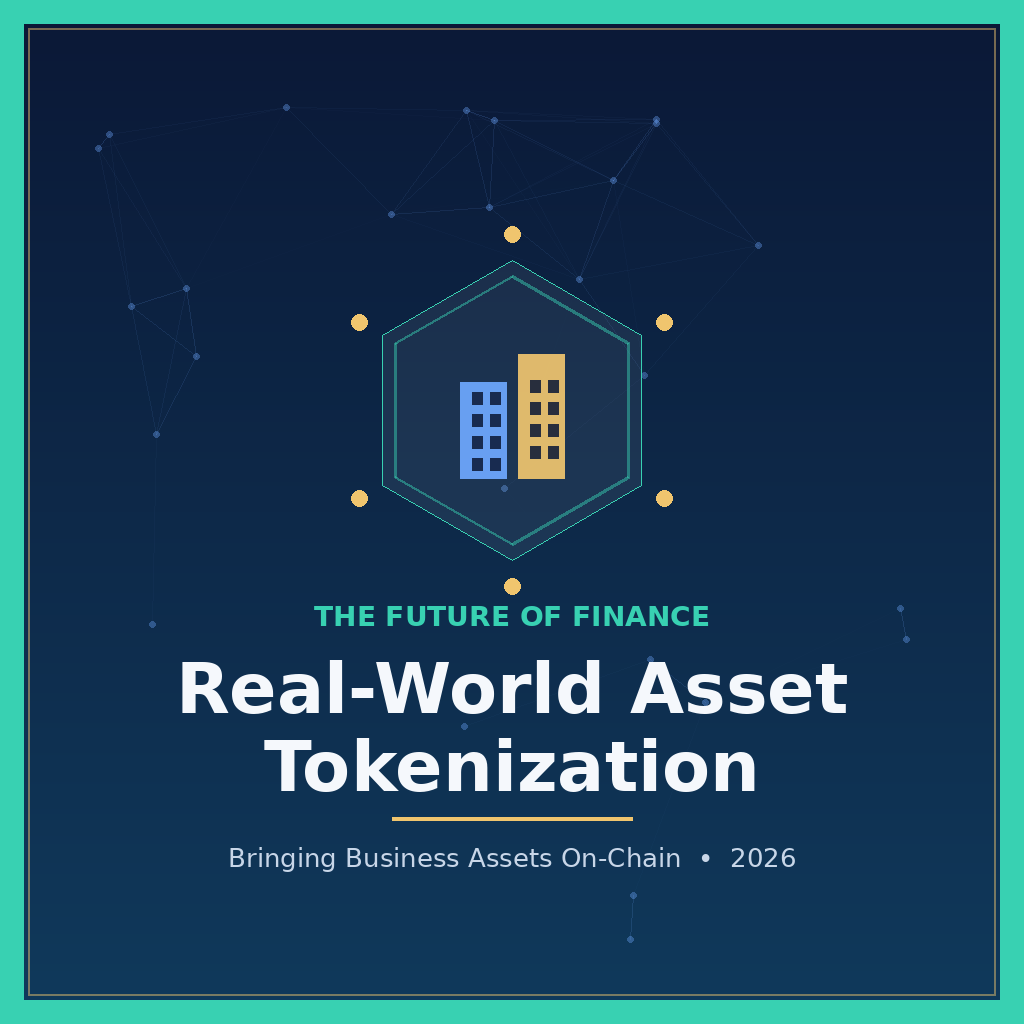
Real-world asset tokenization is moving from pilot projects to core financial infrastructure in 2026.
BUSINESS · DIGITAL FINANCE
Real-World Asset Tokenization in 2026: How Businesses Are Bringing Assets On-Chain
Real-world asset tokenization has quietly become one of the most important business stories of 2026. What started as a niche blockchain experiment is now reshaping how companies raise capital, manage treasury, and give investors access to assets that used to be locked away behind high minimums and slow paperwork. If you run a business, advise one, or simply invest, this is a shift worth understanding.
In plain terms, real-world asset tokenization means taking something that exists off-chain — a Treasury bill, a building, a private loan, a barrel of gold — and issuing a digital token on a blockchain that represents the legal and economic rights to that asset. The token can then settle in seconds, trade around the clock, and plug into automated compliance. For finance teams used to T+2 settlement and stacks of intermediaries, that’s a meaningful upgrade.
Why Real-World Asset Tokenization Matters for Business in 2026
The numbers tell the story. The value of tokenized real-world assets on public blockchains climbed from roughly $5.8 billion in early 2025 to more than $30 billion by April 2026 — a jump of over 420% in about sixteen months, according to data tracked by RWA.xyz. Include stablecoins, and the broader tokenized market sits north of $240 billion.
Three forces are driving that curve. First, regulatory clarity: the U.S. GENIUS Act and the EU’s MiCA framework gave institutions the legal guardrails they were waiting for. Second, real demand for yield and liquidity. Third, the arrival of brand-name issuers — once BlackRock, Franklin Templeton, and J.P. Morgan committed balance-sheet decisions to tokenization, it stopped looking experimental and started looking inevitable.
The shift in one line: Tokenization is increasingly described as a way to modernize existing capital-markets plumbing — not to build a parallel financial system beside it.
Where the Growth Is: Tokenized Asset Categories
Real-world asset tokenization is no longer a single category. By the first half of 2026 it had matured into a diversified ecosystem, with a few segments doing most of the heavy lifting.
Tokenized real-world asset categories, on-chain value (2026)
Category | Approx. on-chain value | What it represents |
|---|---|---|
Private credit | ~$16.8B | SME lending and revenue-based financing brought on-chain |
Tokenized U.S. Treasuries | ~$13–15B | The “risk-free rate” benchmark of digital assets |
Tokenized commodities | ~$5.5B | Mostly gold-backed tokens (Tether, Paxos) |
Real estate | Multi-billion & growing | Fractional ownership of property and developments |
Tokenized equities | ~$0.5B | Early but fast-growing on-chain stock exposure |
Figures are approximate and drawn from RWA.xyz, Coinbase Research, and industry trackers as of Q1–Q2 2026. Categories move quickly, so treat them as a snapshot rather than a fixed scoreboard.
The Business Benefits That Actually Move the Needle
1. Liquidity for assets that never had it
Private credit, real estate, and fund interests are notoriously illiquid. Real-world asset tokenization lets a business divide ownership into tradable units, opening the door to secondary markets and to investors who could never write an eight-figure check.
2. Faster, cheaper settlement
Smart contracts can automate issuance, transfers, and compliance at the asset level. That compresses settlement from days to near-instant and strips out layers of reconciliation cost — a direct win for treasury and operations teams.
3. Programmable yield and collateral
A milestone came in early 2026 when BlackRock’s tokenized BUIDL fund — now around $2.4–2.5 billion — began serving as collateral on decentralized rails. Tokenized Treasuries are increasingly the base collateral of the on-chain system, letting idle cash earn regulated yield instead of sitting still.
What Businesses Should Do Before Tokenizing
Real-world asset tokenization is genuinely powerful, but it touches legal structure, custody, technology, and investor operations all at once — and a weak link in any one layer creates problems everywhere else. A practical starting checklist:
- Get the legal wrapper right. The token must reliably represent enforceable rights to the underlying asset.
- Choose custody deliberately. Decide who holds the asset and the keys, and how that’s audited.
- Build compliance in, not on. KYC/AML and transfer restrictions should live in the token logic.
- Plan for liquidity. A token without a venue to trade on is just a database entry.
Handled well, real-world asset tokenization can widen access, sharpen efficiency, and unlock capital that traditional markets leave stranded. Handled carelessly, it simply digitizes risk. The winners in 2026 are the businesses treating it as serious financial infrastructure — because, increasingly, that’s exactly what it is.
Sources & Further Reading
- Parameter / RWA.xyz — RWA tokenization past the $30B milestone in 2026 — https://parameter.io/real-world-asset-tokenization-explodes-past-30-billion-milestone-in-2026/
- 4IRE Labs — Real World Asset Tokenization 2026: Complete Guide — https://4irelabs.com/articles/real-world-asset-tokenization/
- Coinbase Research — Major Trends in Tokenization — https://www.coinbase.com/institutional/research-insights/research/market-intelligence/major-trends-in-tokenization
- Markets Media — BlackRock, BUIDL and the new financial era — https://www.marketsmedia.com/blackrock-fires-starting-gun-for-a-new-financial-era/
- MetaMask — Real-world asset tokens in 2026 — https://metamask.io/news/real-world-asset-tokens-what-crypto-wallet-users-need-to-know-in-2026
- The Vanderbilt Report — Asset Tokenization in 2026: Blockchain’s Move to the Mainstream — https://vanderbiltreport.com/asset-tokenization-in-2026-blockchains-friendly-move-to-the-mainstream/
Disclaimer: This article is published by Vanderbiltreport.com for general informational and educational purposes only. It does not constitute financial, investment, legal, or tax advice, and should not be relied upon as such. Tokenized and digital assets carry significant risk, including the potential loss of capital, and market figures cited are approximate and subject to change. Always conduct your own research and consult a qualified, licensed professional before making any investment or business decision. Vanderbiltreport.com and its authors accept no liability for actions taken based on this content.