





Artelo Biosciences Advances ART26.12 Into Osteoarthritis

The Pain Ceiling Is Rising
Artelo Biosciences Advances ART26.12 Into Osteoarthritis — and Redefines What Non-Opioid Pain Relief Can Look Like
Chronic pain is the largest area of unmet medical need in global medicine. More than 50 million Americans live with it daily. The tools available to them — primarily NSAIDs, opioids, and corticosteroids — have been in clinical rotation for decades, and the liabilities are well-documented. The market is not waiting for innovation. It is demanding it.
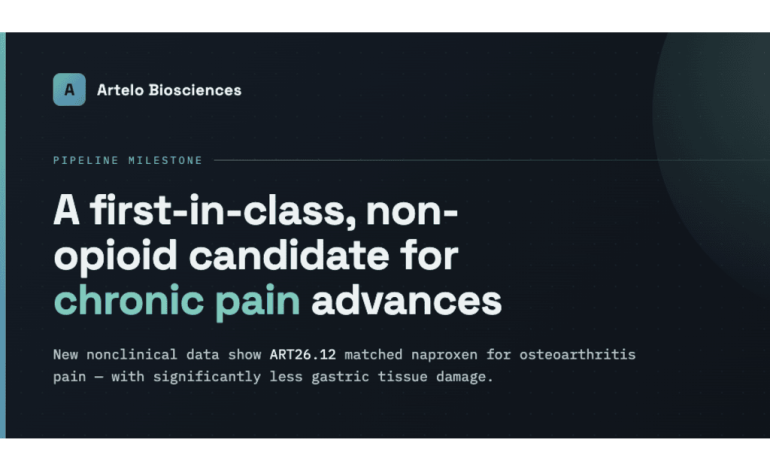
This week, Artelo Biosciences (Nasdaq: ARTL) answered that demand with compelling force. New nonclinical data shows ART26.12, its proprietary FABP5 inhibitor, delivered pain relief statistically comparable to naproxen in an osteoarthritis model — while producing significantly less gastric tissue damage. For a clinical-stage company building toward one of the most consequential therapeutic categories in medicine, this is not a minor data point. It is a credentialing moment.
“The market rarely misprices uncertainty — but it often misreads transformation.”
WHAT THE DATA ESTABLISHES
The study, presented by Dr. Martin Kaczocha, Professor of Anesthesiology at Stony Brook University, at the International Cannabinoid Research Society 2026 Annual Symposium in Dijon, France, evaluated oral ART26.12 in a rodent osteoarthritis model across both acute and chronic dosing periods spanning four weeks.
ART26.12 matched naproxen on pain reduction — and outperformed it on gastric safety. Animals receiving ART26.12 exhibited measurably less non-glandular hyperkeratosis, the early tissue marker for the erosions and ulcers that make long-term NSAID therapy one of the most consequential sources of preventable gastrointestinal morbidity in medicine.
These are not equivalent outcomes presented as equal. ART26.12 achieved analgesic parity through a mechanistically distinct pathway — one that does not rely on cyclooxygenase inhibition and does not carry its gastrointestinal burden. The compound produced distinct changes in endocannabinoid profiles and related bioactive lipids, confirming FABP5 inhibition as a genuine, independent pharmacological target with durable therapeutic signal.
“Osteoarthritis affects more than 30 million Americans and a novel drug such as ART26.12 could provide a new option for patients to achieve pain relief with potentially fewer side-effects compared to existing NSAIDs.”
— Martin Kaczocha, Ph.D., Professor of Anesthesiology, Stony Brook University
A PLATFORM, NOT A COMPOUND
ART26.12 entered development targeting chemotherapy-induced peripheral neuropathy — a high-unmet-need niche with limited competitive crowding. The osteoarthritis results expand that thesis into one of the largest and most commercially significant chronic disease markets in the world.
Osteoarthritis affects an estimated 528 million people globally. In the United States alone, the direct and indirect economic burden runs into the hundreds of billions annually. Artelo is now positioned at the intersection of two pain categories — neuropathic and nociceptive — with a single compound demonstrating efficacy across both. That is a platform story, not a single-indication story.
FABP5 inhibition is proving to be condition-agnostic. Artelo’s preclinical portfolio now spans neuropathic pain, nociceptive pain, certain cancers, psoriasis, and anxiety disorders. Each validated indication is an additional pathway to clinical and commercial leverage — and a strengthening asset for potential licensing or partnership conversations with larger pharmaceutical players seeking next-generation pain franchises.
Critically, ART26.12 has already demonstrated a favorable safety profile in human studies, with no serious adverse events and predictable, linear pharmacokinetics. That human tolerability foundation — now paired with expanding preclinical evidence across multiple pain types — positions ART26.12 with structural advantages that pure efficacy data alone would not convey.
THE NSAID PROBLEM IS THE COMMERCIAL OPPORTUNITY
NSAIDs generated approximately $25 billion in global sales last year. They are the backbone of pain management worldwide. They are also associated with an estimated 100,000 hospitalizations annually in the United States from gastrointestinal complications. Prescribers know the risk. Patients absorb it. Payers fund it.
ART26.12 does not need to displace NSAIDs to create substantial enterprise value. It needs only to earn formulary positioning in the highest-risk patient segments — chronic users, elderly populations, those with prior GI events — to address a commercially significant and underserved market. The preclinical gastric safety data now provides the scientific rationale for exactly that positioning.
“Investors will not reward ambition alone; they reward ambition paired with clear architecture.”
The architecture is now visible and expanding. Each successive dataset from ART26.12 broadens the clinical rationale without requiring the compound to change. That is the hallmark of mechanistic durability — the kind that defines platform drugs and attracts the attention of acquirers, partners, and institutional capital alike.
“The growing body of evidence supporting ART26.12 across multiple pain models, along with a low toxicological non-clinical risk and a well-tolerated clinical profile, reinforces our belief that selective FABP5 inhibition may represent a differentiated approach to treating chronic pain and inflammatory disorders.”
— Andy Yates, Ph.D., Chief Scientific Officer, Artelo Biosciences
THE CATALYSTS AHEAD
Artelo’s pipeline of near-term catalysts is well-defined and sequenced for maximum investor visibility.
Q4 2026 brings the most immediate milestone: enrollment initiation for a multiple ascending repeat dose study in healthy volunteers, generating safety, tolerability, and pharmacokinetic data that advances ART26.12 toward patient populations. On-schedule execution here validates the development timeline and sets the foundation for 2027 efficacy readouts that could represent a significant re-rating event.
The FABP5 platform’s underdiscussed indications — psoriasis and anxiety — represent additional catalysts that have not yet been priced into the current narrative. Any data release or partnership signal in those areas would expand the addressable market thesis and introduce new investor audiences to the Artelo story.
Larger pharmaceutical players with established pain franchises are actively seeking next-generation assets that carry cleaner safety profiles than legacy NSAIDs. ART26.12’s osteoarthritis results make the compound more attractive to that audience than any prior dataset. The licensing and acquisition calculus is improving with each study.
EDITORIAL PERSPECTIVE
The science behind ART26.12 is advancing with a consistency that commands attention. The FABP5 thesis has now been validated across multiple pain models, confirmed in early human studies, and extended into one of the most commercially significant chronic disease markets on the planet.
Osteoarthritis is not a niche. Gastrointestinal safety is not a secondary endpoint. A mechanism of action that delivers NSAID-comparable analgesia through a novel endocannabinoid-lipid pathway — while protecting the gastric tissue that NSAIDs erode — is a structural advance in pain medicine.
Artelo Biosciences is building toward that advance with scientific discipline, a clean human safety record, and a platform that is widening with each publication. The investment community is only beginning to recognize what the data has been signaling for months.
The next phase requires one thing above all: execution.
ARTELO BIOSCIENCES, INC. | NASDAQ: ARTL
This editorial is produced by The Vanderbilt Report for informational purposes only and does not constitute investment advice. The Vanderbilt Report may or may not hold positions in securities mentioned herein. Clinical-stage pharmaceutical investments involve significant risk of total loss.