
Published by Vanderbilt Report · US News · September 17, 2026
Welcome, and thank you for reading. If you woke up to headlines about a Fed rate hike and wondered what it means for your mortgage, your savings, or your portfolio, you are in the right place. On Wednesday, September 16, the Federal Reserve raised its benchmark interest rate for the first time in three years, and the move is already rippling through Wall Street and Main Street alike. Let’s walk through it together, one step at a time.
Fed Rate Hike at a Glance: What Happened
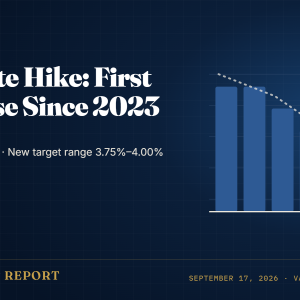
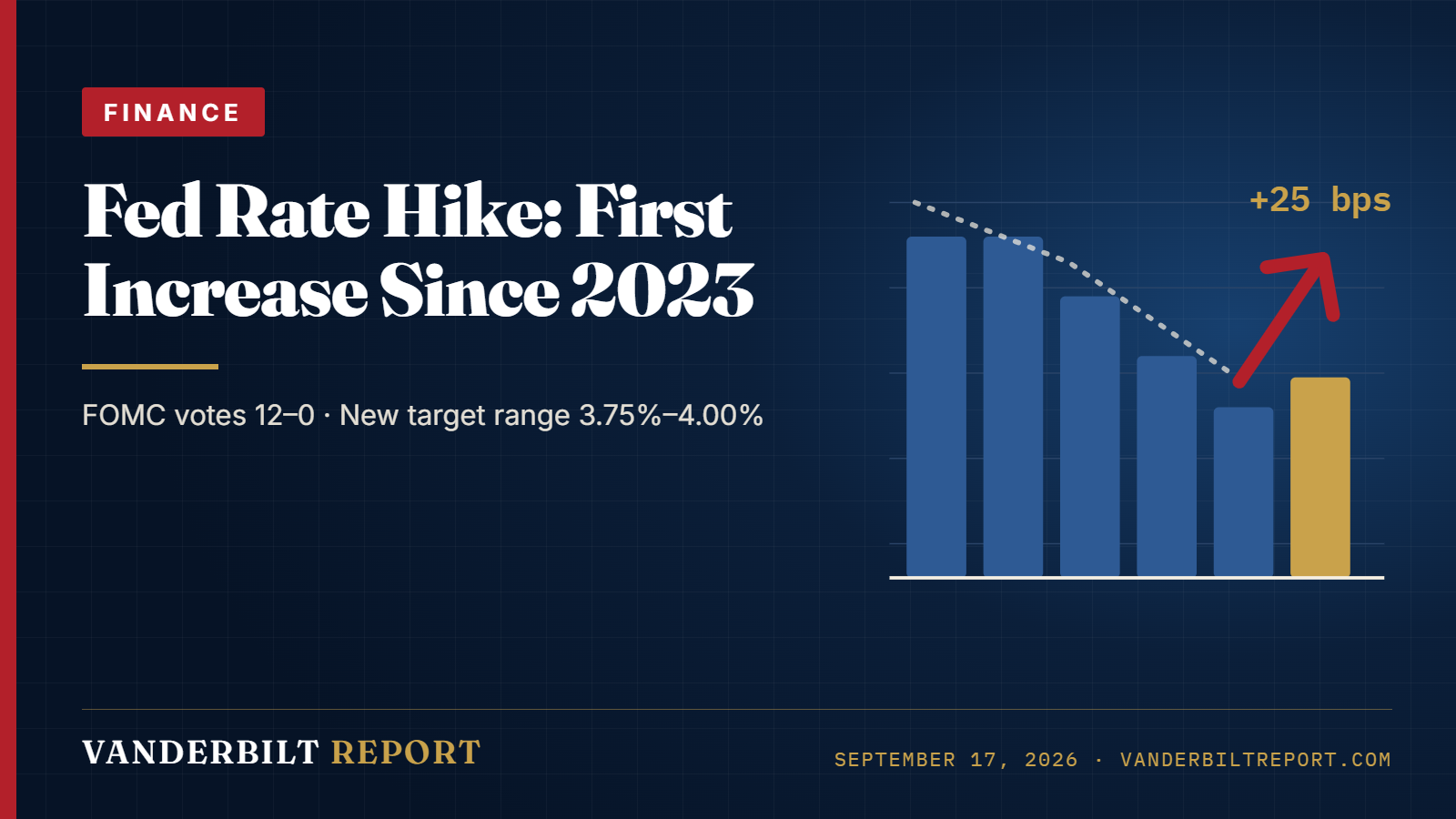
The Federal Open Market Committee voted unanimously, 12–0, to lift the federal funds rate by a quarter of a percentage point, to a target range of 3.75% to 4.00%, according to the Federal Reserve’s official statement. It is the central bank’s first increase since July 2023, as Kiplinger noted in its meeting coverage.
- Size of the move: 25 basis points (0.25 percentage point)
- New target range: 3.75%–4.00%
- Vote: 12–0, with no dissents
- What is next: Officials penciled in one more increase before year-end and another in 2027
Why the Fed Acted Now
In short: prices. The Fed’s statement described an economy growing at a solid pace, with resilient consumer spending, strong productivity, and a stable job market, but said inflation remains elevated relative to its 2% goal. Energy costs and tariffs have added to the pressure, and oil has been trading above $100 a barrel.
Chair Kevin Warsh was direct about the priority. “Inflation is too high and has been for too long,” he told reporters, according to Yahoo Finance. Stronger-than-expected August retail sales, up 1.2%, reinforced the view that households are still spending, giving policymakers room to tighten.
The unanimous vote matters, too. A Fed rate hike backed by every voting member tells markets that the committee is aligned, which makes the guidance about further increases more credible.
How Markets Responded
Investors took the news with some nerves. The Dow Jones Industrial Average fell roughly 600 points, or about 1.2%, while the S&P 500 slipped 0.4% and the Nasdaq Composite finished close to flat, Yahoo Finance reported. In the bond market, the 10-year Treasury yield climbed above 5%, its highest level since 2007.
For ongoing coverage, CNBC and Bloomberg are tracking the market reaction as trading continues this week.
What the Fed Rate Hike Means for Your Wallet
Here is the friendly, practical version. A Fed rate hike does not change every rate overnight, but it nudges many of them in the same direction.
Borrowers
Credit cards, home equity lines, and other variable-rate loans tend to follow the Fed fairly quickly, so balances may cost a little more to carry. Mortgage rates take their cue mostly from longer-term Treasury yields, and with the 10-year above 5%, home loan costs could stay elevated for now.
Savers
There is good news here. Higher benchmark rates typically translate into better yields on savings accounts, certificates of deposit, and money market funds. It may be a good moment to compare what your bank is paying.
Investors
Higher rates can weigh on stock valuations, particularly for companies that rely on borrowing, while making newly issued bonds more attractive. Wednesday’s uneven market reaction, with the Dow down sharply and the Nasdaq nearly unchanged, shows that the effects are not uniform across sectors.
What to Watch Next
The Fed’s projections point to at least one more increase in 2026 and one in 2027, with the longer-run rate seen between 3.0% and 4.0%. Whether that path holds depends on the data. As Brandon Zureick of Johnson Investment Counsel told Kiplinger, future moves hinge on incoming inflation readings, which have been heavily shaped by energy markets.
Keep an eye on three things in the weeks ahead:
- Monthly inflation reports, especially energy and core prices
- Oil prices and any shift in geopolitical risk
- Comments from Fed officials ahead of the next policy meeting
The Bottom Line
This Fed rate hike marks a real turning point after three years without an increase. For most households, the sensible response is a calm one: review any variable-rate debt, shop around for better savings yields, and avoid making big portfolio changes based on a single day of trading. We will keep following the story here at Vanderbilt Report and will update you as the picture develops. Thanks for spending a few minutes with us.
Sources
- Federal Reserve: FOMC statement, September 16, 2026
- CNBC: Fed rate decision September 2026
- Yahoo Finance: Stock market today, September 16, 2026
- Kiplinger: September Fed meeting updates and commentary
- Bloomberg: Stock market today live updates
- Just Security: Early Edition, September 17, 2026
Disclaimer: This article is published by Vanderbiltreport.com for general informational purposes only. It does not constitute financial, investment, legal, or tax advice, and nothing here should be read as a recommendation to buy or sell any security. Information is drawn from the third-party sources linked above and is believed to be accurate at the time of publication, but Vanderbiltreport.com makes no guarantee of its completeness or accuracy and is not responsible for the content of external sites. Markets and policy can change quickly; please consult a licensed financial professional before making financial decisions.