


Anthropic’s IPO, Microsoft’s Breakaway, and ChatGPT’s New Memory

AI & Machine Learning • Weekly Brief
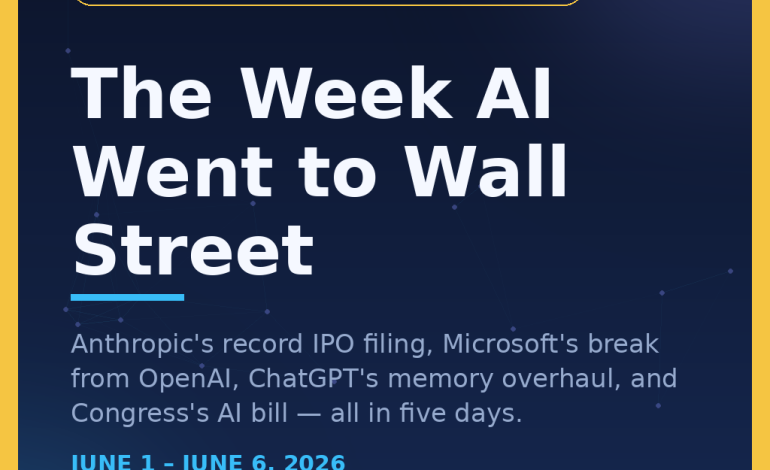
The Week AI Went to Wall Street: Anthropic’s IPO, Microsoft’s Breakaway, and ChatGPT’s New Memory
Five days in early June 2026 packed in a record-setting IPO filing, a Big Tech divorce, a major consumer-AI upgrade, and the most serious federal AI bill Congress has produced yet. Here’s what actually happened and why it matters.

If you blinked last week, you missed a lot. Between June 1 and June 6, 2026, the artificial intelligence industry served up one of its densest news cycles in memory: the most valuable AI startup on the planet quietly started the clock on going public, Microsoft stopped renting its intelligence and started building its own, ChatGPT got a memory that works the way you’d actually expect it to, and a pair of lawmakers from opposite parties dropped a 269-page blueprint for how America should govern the whole thing. Below, we walk through the five stories that mattered most, plus the smaller items worth keeping on your radar.
1. Anthropic files for what could be the biggest AI IPO in history
On June 1, Claude maker Anthropic confidentially submitted a draft registration statement on Form S-1 to the U.S. Securities and Exchange Commission, formally starting its path toward a public listing. The move makes Anthropic the first major frontier-AI lab to begin the IPO process — beating its chief rival, OpenAI, to the starting line.
The timing isn’t an accident. The filing landed just days after Anthropic closed a $65 billion Series H round that pushed its post-money valuation to roughly $965 billion, making it the most valuable private AI company ever and, for the first time, eclipsing OpenAI’s last reported valuation. Reporting from Fortune and CNBC pegs the company’s annualized revenue run-rate near $47 billion — up from roughly $10 billion a year earlier — driven largely by enterprise adoption of Claude for coding and agentic workflows.
A confidential filing is an option, not a commitment: no share count, price range, ticker, or listing date has been set, and the company stressed the offering depends on SEC review and market conditions. Still, analysts widely expect a fall 2026 debut, with a trillion-dollar valuation as the realistic base case if markets stay friendly. Together with pending mega-listings from SpaceX and an expected OpenAI filing, it points to the busiest year for tech IPOs in a decade.
2. Microsoft cuts the cord with the MAI model family
At Microsoft Build 2026 in San Francisco on June 2, CEO Satya Nadella delivered a message the company has been hinting at for two years: Microsoft no longer wants to be just an investor in other people’s AI. It unveiled MAI (Microsoft AI), a family of seven proprietary models built entirely in-house.
The headliner is MAI-Thinking-1, Microsoft’s first reasoning model — a sparse mixture-of-experts system with about 35 billion active parameters and a 256,000-token context window, trained from scratch on commercially licensed data with no distillation from OpenAI or any other third party. That data provenance is a deliberate pitch to enterprise customers with strict compliance needs. Alongside it came MAI-Code-1-Flash, a “text-to-code” model now rolling out across GitHub Copilot and Visual Studio Code, aimed squarely at the booming “vibe coding” market.
“We believe the time has come for every company to move from consuming a frontier model to fully participating at the frontier.” — Satya Nadella, Microsoft CEO, at Build 2026
The logic is mostly economic. Microsoft has put roughly $13 billion into OpenAI and up to $5 billion into Anthropic, and it still resells both through Azure — but as frontier-model usage costs climb, its own efficient models let it capture more margin and pass savings to developers. As Euronews and HotHardware noted, MAI also serves as a strategic hedge should the OpenAI relationship sour. Early benchmarks suggest the family is competent rather than category-defining — but that may be beside the point.

3. ChatGPT learns to remember you: OpenAI’s “Dreaming V3”
On June 4, OpenAI rolled out Dreaming V3, the biggest overhaul of ChatGPT’s memory since the feature launched. Instead of asking the assistant to “remember this,” a background process now reads across years of past conversations, synthesizes them, and builds a running picture of who you are — your projects, preferences, travel, and routines.
The clever part is temporal awareness: tell ChatGPT you’re traveling to Singapore in July, and after the trip it quietly updates the memory to reflect that you went, with no manual correction. OpenAI says it cut the compute required for the feature by roughly 5x, which is how it plans to bring memory to the free tier for the first time. A new Memory Summary page lets users see and edit exactly what the assistant knows, and temporary chats stay private and don’t feed the system.
The rollout arrives with regulatory clocks ticking. The EU AI Act’s transparency obligations for chatbot systems take effect August 2, 2026, meaning OpenAI will need to meet new disclosure standards almost immediately after shipping its most ambitious memory architecture yet. (This story was reported by industry outlets covering the June 4 rollout; OpenAI’s tiered availability is expanding in the weeks following launch.)
4. Anthropic’s other headline: 80% of its code, written by Claude
Anthropic’s IPO wasn’t its only news. The company disclosed that more than 80% of the code merged into its production codebase in May 2026 was authored by its own model, Claude. But the framing was a warning, not a victory lap: Anthropic urged all frontier labs to agree on a coordinated, verifiable way to slow or pause development if advanced systems begin improving themselves faster than society can manage, arguing that unilateral restraint wouldn’t be enough.
The disclosure lands alongside the company’s latest flagship, Claude Opus 4.8, which the company reports scores 88.6% on the SWE-bench Verified coding benchmark and introduces parallel sub-agent workflows. Taken together, the two Anthropic stories capture the central tension of this AI moment: the same capabilities fueling a near-trillion-dollar valuation are the ones prompting the company to ask for collective brakes.
5. Washington makes its move: the Great American AI Act
On June 4, Representatives Jay Obernolte (R-CA) and Lori Trahan (D-MA) released a discussion draft of the Great American Artificial Intelligence Act of 2026 — a 269-page bipartisan framework for federal AI governance. Per the lawmakers’ joint announcement and analysis from DLA Piper and FedScoop, the headline provisions include:
- A three-year federal preemption of state laws that specifically regulate how AI models are developed — while leaving states free to regulate how AI is used in areas like employment, healthcare, and consumer protection.
- $100 million per year (FY2027–2029) to codify and fund a Center for AI Standards and Innovation within the Commerce Department.
- Binding safety and transparency requirements on “large frontier developers” — companies with more than $500 million in annual revenue that train the most powerful models.
- Cybersecurity provisions and workforce-impact studies responding to AI-driven threats.
Reaction split fast. Industry groups such as the Business Software Alliance called it a “credible and substantive” starting point, while consumer advocates including Public Citizen condemned the preemption clause for stripping states of their role as a safety backstop. The draft is not yet formally introduced; the sponsors are gathering public feedback. It arrived two days after President Trump signed a separate executive order asking AI companies to voluntarily share frontier models with the government for review before public release.
Also worth knowing this week
- Google’s $80B war chest. Alphabet moved to raise roughly $80 billion in equity to fund its AI infrastructure buildout, alongside new water commitments for its data centers.
- GitHub Copilot’s billing backlash. A June 1 switch to token-based billing sparked developer anger, with some users reporting that bills could jump from $29/month into the hundreds under heavy use.
- Supabase hits $10.5B. The backend platform rode the vibe-coding wave to a fresh valuation, underscoring how much investor money is flowing into AI-native developer tools.
- The CREATOR Act. A bipartisan bill was introduced to give visual artists federal protection against AI-generated imitations of their style — the first major proposal of its kind.
The week at a glance
| Story | Key player | Date | Why it matters |
|---|---|---|---|
| Confidential IPO filing at ~$965B | Anthropic | Jun 1 | First frontier lab to start going public; sets a price benchmark for AI |
| MAI in-house model family | Microsoft | Jun 2 | Reduces reliance on OpenAI; pushes down developer costs |
| “Dreaming V3” memory upgrade | OpenAI | Jun 4 | Persistent, self-updating memory comes to ChatGPT’s free tier |
| 80% of code written by Claude + pause call | Anthropic | Jun 4 | Frames self-improving AI as an industry-wide safety question |
| Great American AI Act (draft) | U.S. Congress | Jun 4 | Could create a single national rulebook and preempt state laws |
The bigger picture
Step back and a pattern emerges. The model layer is racing toward commodity status — which is exactly why the week’s biggest moves were about everything around the models: capital (Anthropic’s filing), control (Microsoft’s in-house pivot), the consumer relationship (ChatGPT’s memory), and the rules of the road (Congress’s draft). The companies winning in mid-2026 aren’t just shipping smarter systems; they’re locking in the financing, infrastructure, distribution, and policy footing to deploy them at scale. Expect that contest — not raw benchmark scores — to define the second half of the year.
Sources & further reading
- Fortune — “Anthropic confidentially files for IPO at $965 billion valuation”: fortune.com
- CNBC — “Microsoft unveils new AI models to lessen reliance on OpenAI”: cnbc.com
- Euronews — “Microsoft launches its own AI models to take on OpenAI and Anthropic”: euronews.com
- HotHardware — “Microsoft Reduces OpenAI Dependency With In-House Frontier Models”: hothardware.com
- Office of Rep. Jay Obernolte — Great American AI Act discussion-draft announcement: obernolte.house.gov
- DLA Piper — “Unpacking the Great American AI Act”: dlapiper.com
- FedScoop — “Bipartisan ‘Great American AI Act’ draft proposes new federal AI governance framework”: fedscoop.com
- Public Citizen — statement on the Obernolte-Trahan draft: citizen.org
- Industry roundup of the June 1–6 news cycle (OpenAI “Dreaming V3,” Anthropic disclosures, quick hits), DevQuill Insights via Medium: medium.com
Disclaimer: This article is published by VanderbiltReport.com for general informational and educational purposes only. It is a journalistic summary compiled from publicly available third-party reporting as of June 9, 2026, and does not constitute financial, investment, legal, or professional advice. References to companies, valuations, products, and pending legislation reflect reporting available at the time of writing and may change; figures such as private valuations and IPO details are preliminary and unverified by Vanderbilt Report. Mention of any company or security is not a recommendation to buy, sell, or hold. Vanderbilt Report is not affiliated with and does not endorse any organization named here. Readers should consult the original sources and qualified professionals before making any decisions. © 2026 VanderbiltReport.com. All rights reserved.