


US Strikes on Iran Escalate for a Second Day as Strait of Hormuz Dispute Rattles Oil Markets

BREAKING NEWS By Vanderbilt Report Staff | Updated June 11, 2026
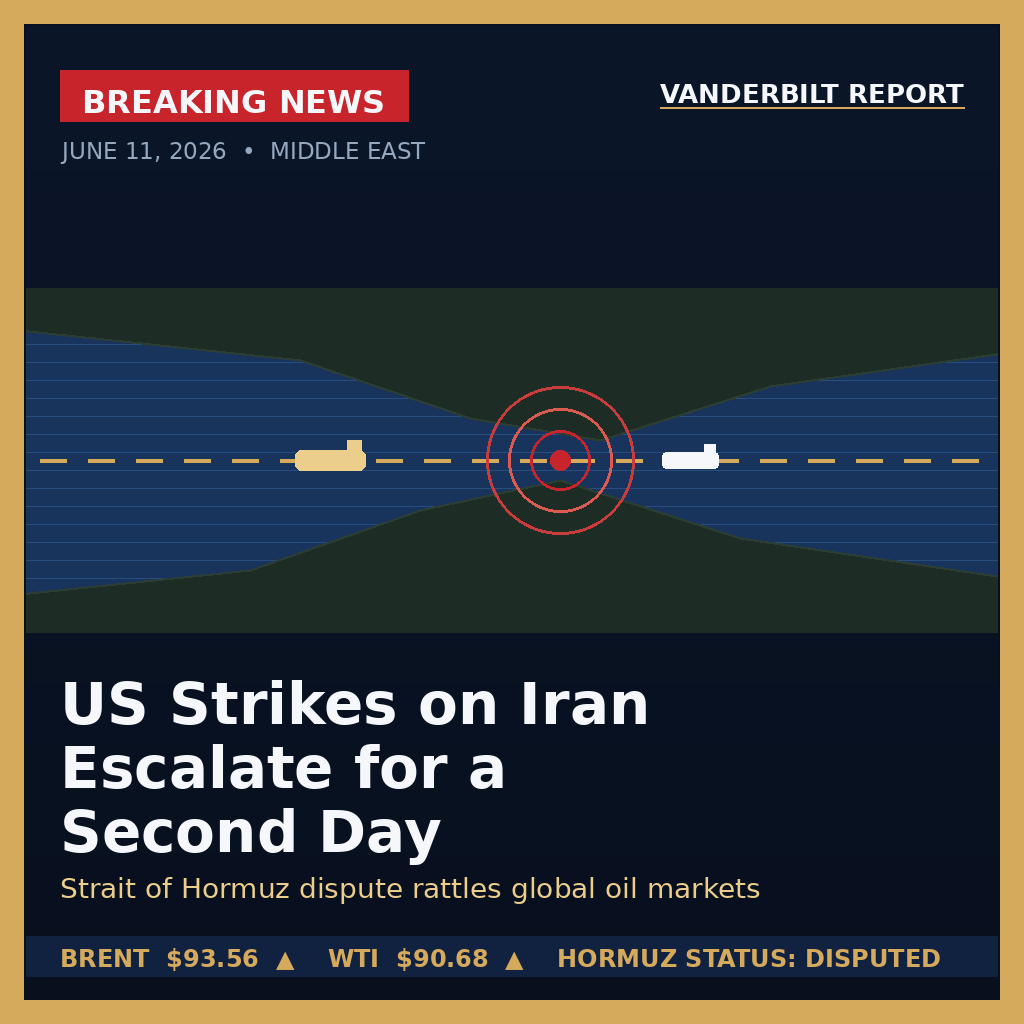
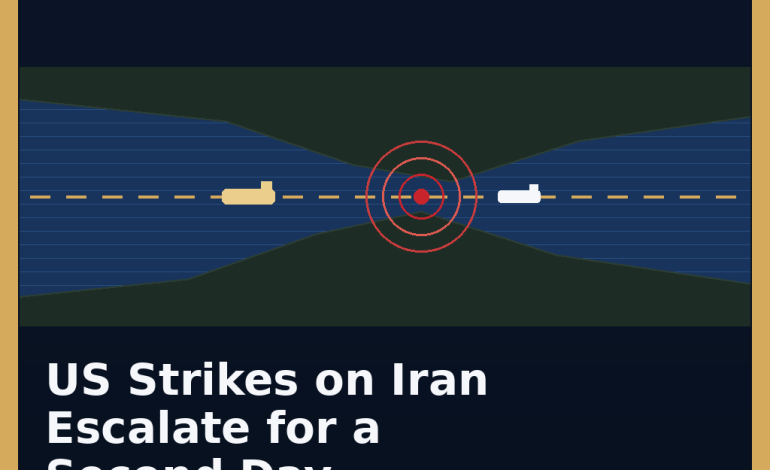
A fresh round of US strikes on Iran rolled into a second straight day on Wednesday into Thursday, June 11, pushing a fragile spring ceasefire to the brink and sending jitters through global energy markets. Explosions were reported across several Iranian sites overnight. Tehran says it has shut the Strait of Hormuz, and Washington insists the world’s most important oil chokepoint is still open. Here’s a friendly, plain-English rundown of what happened, who’s saying what, and why it matters far beyond the Gulf.
What just happened
The latest US strikes on Iran began shortly after midnight near Tehran, according to U.S. Central Command, with blasts heard in Qeshm, Bandar Abbas, Minab, and Sirik, per The New York Times. President Donald Trump had signaled the escalation in advance, warning that the U.S. would hit Iran hard again and saying Washington intends to take what he called “total control” of the country’s oil and gas industry. Defense Secretary Pete Hegseth, speaking from Central Command, framed the new wave as pressure to shape a deal rather than to restart a full war.
Iran responded in kind. Tehran said it struck U.S. positions at bases in Kuwait, Bahrain and Jordan, and its foreign ministry declared that the renewed attacks had rendered the April 8 ceasefire meaningless. Iran also claimed it had fully closed the Strait of Hormuz to all vessels — a claim U.S. Central Command publicly denied.
Tragically, the human toll is already widening. According to RFE/RL, three Indian sailors were confirmed dead after a U.S. strike on the Palau-flagged tanker MT Settebello off the coast of Oman, prompting India to lodge a formal protest with Washington.
A quick timeline
How the US strikes on Iran reached this point
Date (2026) | Development |
Feb 28 | U.S. and Israel launch strikes on Iran; the war begins. |
Mar 19 | U.S. opens an air campaign aimed at reopening the Strait of Hormuz. |
Apr 7–8 | U.S. and Iran agree to a ceasefire; Iran agrees to reopen Hormuz. |
Apr 13 | U.S. imposes a naval blockade on Iran after talks stall. |
Jun 10 | U.S. launches a new wave of strikes; the ceasefire starts to unravel. |
Jun 11 | Second day of exchanges; Iran claims Hormuz is closed, the U.S. denies it. |
Why the latest US strikes on Iran matter for oil
Roughly a fifth of the world’s seaborne oil moves through the Strait of Hormuz, so any threat to traffic there ripples quickly into prices at the pump. After the renewed US strikes on Iran, crude climbed: U.S. crude futures rose about 0.72% to $90.68 a barrel, while Brent, the international benchmark, ticked up to roughly $93.56, per CNBC. Trump’s comments about seizing Iranian oil infrastructure — including a reference to Kharg Island — nudged prices higher shortly after he spoke.
Market snapshot — morning of June 11, 2026
Indicator | Level | Move |
Brent crude | ~$93.56 / bbl | ▲ 0.48% |
WTI crude | ~$90.68 / bbl | ▲ 0.72% |
S&P 500 | — | ▲ 0.21% |
Dow Jones | — | ▲ 0.45% |
Nasdaq | — | ▲ 0.26% |
Russell 2000 | — | ▼ 1.10% |
Interestingly, markets stayed relatively calm. Analysts at Rystad Energy noted the oil market is better-positioned to absorb disruptions than in past crises, pointing to record U.S. crude exports, softer Chinese demand and alternative export routes that reduce reliance on Hormuz. Even so, Rystad’s Jorge Leon cautioned that the odds of a near-term diplomatic breakthrough have dimmed, leaving prices vulnerable to sharp swings.
The wider picture
This flare-up sits inside a conflict that has now passed its 100-day mark. Alongside the US strikes on Iran, Israel has continued operations against the Iran-backed group Hezbollah in Lebanon, where the Lebanese health ministry reports more than 3,600 people killed. In a striking escalation of rhetoric, Iranian state media (via CNBC) signaled that Tehran would treat Elon Musk’s companies in the region, including SpaceX’s Starlink service, as potential military targets.
The renewed exchanges have, in Iran’s words, left the April ceasefire effectively without meaning — while Washington argues the pressure is meant to force a deal, not a wider war.
What to watch next
- Hormuz status: Whether shipping data confirms Iran’s closure claim or backs the U.S. denial.
- Energy infrastructure: So far, the latest strikes reportedly avoided Iran’s oil and gas facilities; that could change.
- Diplomacy: Any signal of renewed talks — or a hardening of positions on sanctions relief.
- Markets & the Fed: Europe’s central bank has already moved on rates, and the U.S. Federal Reserve is set to weigh in next week.
The bottom line
The second day of US strikes on Iran marks a sharp turn away from the calm that briefly followed April’s ceasefire. With Tehran claiming Hormuz is closed, Washington denying it, and energy traders watching every headline, the next few days could decide whether this is a short, contained burst of pressure or the start of a longer, costlier chapter.
Sources
- The New York Times — reporting on overnight strikes and Iran’s ceasefire response (via Just Security’s Early Edition, June 11, 2026).
- Associated Press — coverage of strikes, casualties, and Trump’s “total control” remarks.
- BBC News — reporting on attacks involving vessels with Indian crews.
- RFE/RL (Radio Farda) — updates on the MT Settebello strike and Hormuz closure claim.
- CNBC — crude oil price moves, Kharg Island remarks, and Starlink-as-target report.
- TheStreet — June 11, 2026, stock-market levels and Trump’s escalation comments.
- Trading Economics — crude oil price data and inventory figures.
- Encyclopaedia Britannica — background on the 2026 Iran war and Strait of Hormuz disruptions.
Disclaimer: This article is published by Vanderbiltreport.com for general informational purposes only and reflects a developing news situation as of June 11, 2026. Details may change as events unfold. The content is compiled from publicly available third-party news reports cited above and does not constitute financial, investment, legal, or professional advice. Vanderbiltreport.com makes no warranty as to the accuracy or completeness of any third-party information and is not responsible for decisions made based on this content. All trademarks and source publications belong to their respective owners.