



Two contract announcements in eight days, a half-billion-dollar backlog, and a sector that is already paying for safety. The question for Nasdaq: RZAI is no longer whether demand exists, but how quickly it converts.
NASDAQ: RZAI
The fire-safety industry was built to answer one question: is there a fire right now? Roze AI is built to answer a different one: is there about to be?
That distinction is the entire thesis. And in the two weeks since its Nasdaq debut, the company has begun turning it into signed paper.
Detection tells you what happened. Forecasting tells you what to do next.
The Structural Problem: Detection Arrives Late
Most fire-protection infrastructure still reacts to heat or smoke after combustion has begun. It is reliable, code-compliant and, by design, late. The market built around it is large and steady. Grand View Research values the global fire protection system market at $94.9 billion in 2025 and projects $156.2 billion by 2033, a 6.4% compound annual rate, with artificial intelligence, IoT and smart sensors cited as growth drivers.
What is changing is not the size of the market. It is the architecture inside it.
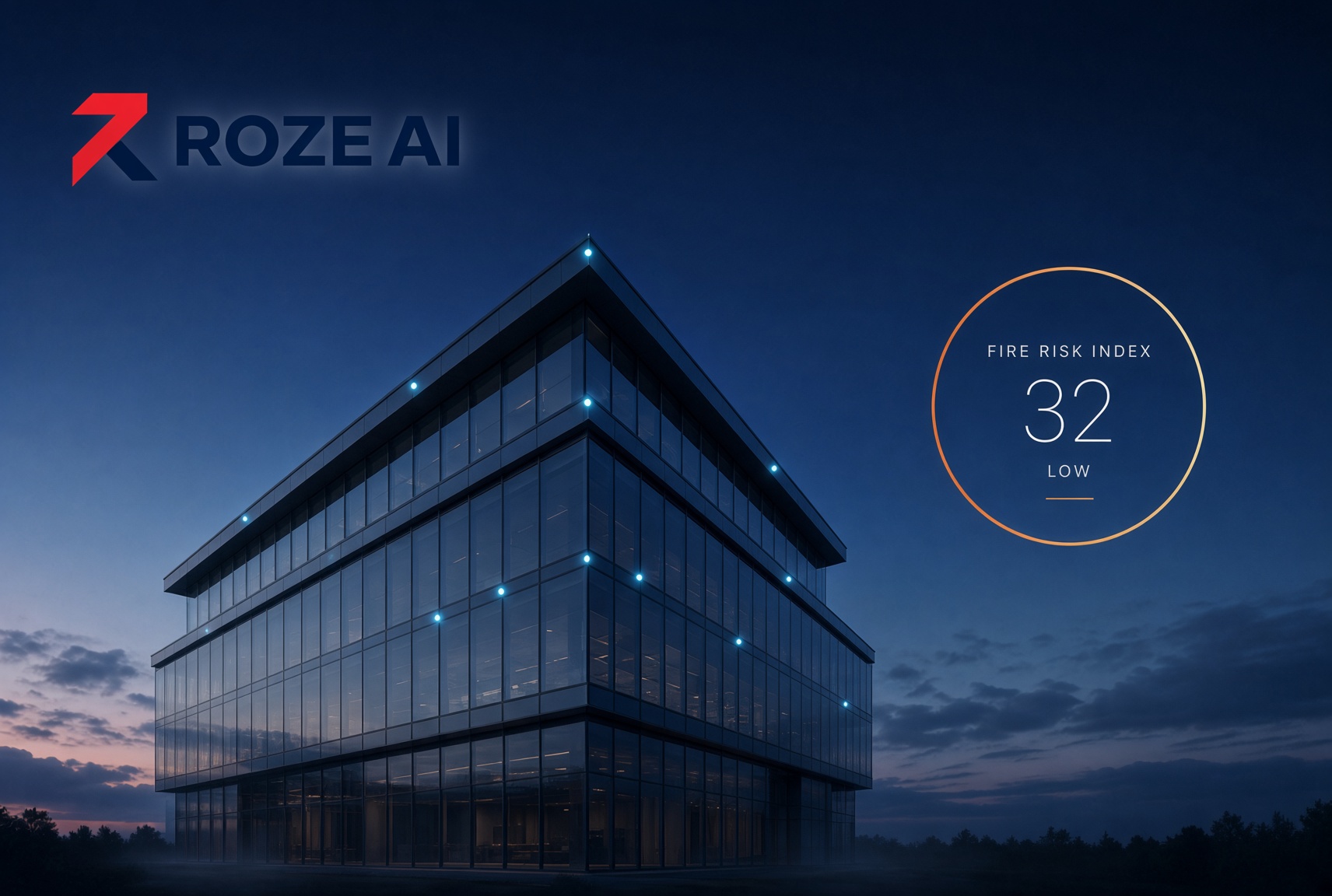
Roze AI, a British Columbia holding company operating through Roze AI Korea in Seongnam, sells a Disaster AI Platform that combines wireless sensors, a digital twin of the facility and data analytics to generate a Fire Risk Index. Its Fire 4Cast system works more like a weather service than an alarm: it reads conditions continuously and flags elevated risk before flames appear. The company recently completed U.S. trademark registration for FIRE 4CAST.
The platform is not theoretical. According to its F-1, Roze AI served 93 active customers in 2025, 66 of them new, with deployments spanning Korean Army, Navy and Air Force bases, Gimhae International Airport, POSCO steelworks, power plants, hospitals and schools. It holds 20 registered patents and is designing a dedicated system-on-chip as a fabless developer to push more processing to the edge.
“Our team has spent years developing technology that uses sensor data and AI to assess risks before a fire occurs.” — Young Jin Cho, Chief Executive Officer
Two Weeks, Six Contracts
On October 6, Roze AI announced three contracts worth KRW 16.4 billion, roughly $12.2 million excluding VAT, covering two mixed-use sites for developer Hajo in Seocho, Seoul, and a commercial development for IJ at the new Soraepogu Fish Market in Incheon. Including VAT, the total was approximately $13.4 million.
Eight days later, on October 13, the same two customers came back. Hajo awarded Hapjeong Districts 5 and 6 in Mapo-gu, Seoul, at approximately $6.10 million and $7.49 million, and IJ added Nonhyeon ALT2 at approximately $1.22 million, for an aggregate of KRW 19.88 billion, or about $14.8 million including VAT.
Taken together, that is roughly $28 million in new contract value in eight days, against fiscal 2025 revenue of $2.3 million. It is more than twelve times last year’s top line.
The more important detail is who signed. These are repeat orders from existing customers on redevelopment projects, not pilot programs. Repeat awards from the same developers, within days of each other, are the clearest form of customer validation a contractor-facing business can show.
“These contracts … reflect growing demand from developers for preventive fire safety in large residential and mixed-use projects.” — Young Jin Cho
The policy backdrop is moving in the same direction. On September 23, Korea’s Ministry of the Interior and Safety announced measures to supply automatic fire extinguishers to 6.68 million aging apartment units without sprinklers and to expand smoke-detector distribution to 8.97 million households. Preventive fire safety in Korean housing is becoming public policy, not a premium feature.
The Sector Is Already Paying for Safety
Roze AI does not have to persuade investors that life safety is a durable spend category. Its larger peers have already done that work.
APi Group, a global fire and life-safety services provider that entered the Fortune 500 this year, has raised its 2026 outlook repeatedly this year, most recently to $8.875–$9.025 billion in revenue, and reports a record backlog above $5 billion. It has been an active acquirer, closing Onyx-Fire in Canada and WTech Fire Group in Europe, together adding roughly $365 million in annual revenue. Citi carries a Buy rating with a $54 target.
Evolv Technology offers the closer analogue: AI applied to physical safety. Its second-quarter revenue rose 34% to $43.8 million, it added 70 new customers, and it lifted 2026 guidance to $180–$185 million while targeting roughly 25% compound revenue growth through 2031. The market has rewarded the proof that AI can be sold as safety infrastructure rather than software novelty.
Company | Position in the chain | Most recent signal | Scale |
APi Group (NYSE: APG) | Fire and life-safety services, installation and inspection | Raised 2026 guidance to $8.875–$9.025 billion in revenue; record backlog above $5 billion; closed Onyx-Fire and WTech Fire acquisitions | ~$9B revenue |
Evolv Technology (NASDAQ: EVLV) | AI-powered physical security screening | Q2 2026 revenue of $43.8 million, up 34%; 70 new customers; 2026 outlook raised to $180–$185 million | ~$180M revenue |
Roze AI (NASDAQ: RZAI) | AI fire-risk forecasting, wireless sensing, digital twin | ~$28 million in new contracts announced in eight days; $526.8 million backlog across 32 projects at year-end 2025 | $2.3M FY25 revenue |
Sources: company filings and press releases, July–October 2026. Roze AI contract total includes Korean VAT.
Capital is following the same logic further upstream. Crunchbase data show venture investment in physical AI in the first half of 2026 ran nearly four times the $12 billion raised in the second half of 2025, and exceeded the $41.9 billion invested across 2022, 2023 and 2024 combined. Sensors and industrial automation are explicitly inside that definition.
While most of that capital is chasing robots and autonomous vehicles, Roze AI sits in a quieter corner of physical AI: one with building codes, procurement lists and liability on its side.
What the Market Is Missing
RZAI listed through a direct listing on September 29, reached an intraday high of $35.55 on October 1, and has since reset to roughly $10.58, where it traded today after a 6.1% gain on the latest contract news. That leaves a market value below $600 million.
Set against that, the F-1 discloses a total backlog of $526.8 million across 32 contracted projects as of December 31, 2025, with 13 projects worth approximately $252.2 million expected to begin execution or partial revenue recognition within twelve months. The company now trades at roughly one times its disclosed backlog, before counting October’s awards.
The market is pricing the revenue line. The filing describes the order book.
The gap between those two figures is where the opportunity sits. Fire-safety work tied to construction is recognized as projects are built, and Roze AI’s 2025 revenue of $2.3 million, down from $8.2 million in 2024, reflected project timing and macro conditions while the customer base kept expanding to 93 active accounts. The October awards follow the same path, with construction slated to begin in the first half of 2027, extending revenue visibility into the next fiscal year.
The capital structure is positioned for that build-out. A $10 million Class C preferred placement closed in September, and the Nasdaq listing gives the company a public currency and a broader investor base as it scales into its order book.
The demand is signed. The revenue is scheduled.
What Leadership Should Do Next
The founder lens favors Roze AI on vision. Young Jin Cho has led IT businesses in the United States and Korea for more than three decades, and the product has a decade of field deployment behind it. The next phase is about converting credibility into cadence.
Three priorities stand out. First, publish a backlog conversion schedule, even a range, so investors can track signed value against recognized revenue quarter by quarter. Second, secure the capital runway on terms that protect common holders, and say so plainly. Third, convert one international reference customer, in Vietnam or North America, where fire codes and insurers would validate Fire 4Cast outside its home market.
The next phase requires one thing above all: conversion.
What Investors Should Watch
Several milestones will define the next chapter. The company’s first financial report as a public company will show the 13 projects slated for the next twelve months moving into revenue. Further awards from Hajo, IJ and new developers will confirm October as the start of a cadence. Progress on the system-on-chip, the PDI Global relationship and entry into Vietnam and North America will carry the platform beyond Korea. And Korea’s aging-housing safety program gives preventive fire technology a national tailwind that Roze AI is positioned to meet.
Roze AI arrives on Nasdaq with what many small-cap AI listings are still searching for: repeat customers, a signed order book and a category the market already rewards. As that backlog moves into revenue, the story shifts from potential to performance.
The industry detects fire. Roze AI is building the business of seeing it coming.
Disclosures
This article is published by The Vanderbilt Report for informational purposes only and does not constitute investment advice or an offer or solicitation to buy or sell any security. Information is drawn from the company’s SEC filings and press releases, peer company disclosures and third-party market data, and is believed reliable but is not guaranteed. Share prices, market values and currency conversions are approximate as of October 13, 2026. This article contains forward-looking statements, which are subject to risks and uncertainties, including project timing, capital requirements and other factors described in the company’s SEC filings. Actual results may differ materially. Readers should review the company’s filings and consult a licensed financial professional before making investment decisions.