
Viking Therapeutics (NASDAQ: VKTX) reported new data on Tuesday that go after one of the biggest open questions in obesity medicine: what happens after the weight comes off. In the VK2735 maintenance study, a placebo-controlled trial of its GLP-1/GIP agonist, patients kept most of their lost weight after they moved from weekly injections to every-other-week or monthly doses. This Biotech Weekly looks at what the company reported, what the numbers do and do not show, and the catalysts ahead for the program.
How to read this article: items marked Verified come straight from the company’s release or regulatory documents. Company statement is Viking’s own description or view. Reported means news coverage, linked in each section. Analysis is Vanderbiltreport context, not fact.
VK2735 Maintenance Study at a Glance
| Item | Detail | Status |
|---|---|---|
| Company | Viking Therapeutics, Inc. (NASDAQ: VKTX), San Diego | Verified |
| Drug | VK2735, a dual GLP-1 / GIP receptor agonist | Verified |
| Study | Randomized, double-blind, placebo-controlled; about 180 adults with obesity (BMI ≥30) | Verified |
| Design | 21 weeks of weekly injections (induction), then 12 weeks on a lower-frequency regimen or placebo | Verified |
| Induction result | 16.3%–18.7% mean weight loss at Week 21 vs. 0.1% on placebo | Verified |
| Maintenance result | Up to 97% of weight loss maintained (every other week); up to 90% (monthly); 61% after switching to placebo | Verified |
| Data type | Topline results, company-reported; not yet peer reviewed | Verified |
| Announced | September 22, 2026 | Verified |
Who Is Viking Therapeutics?
Verified. Viking is a clinical-stage biopharmaceutical company focused on metabolic and endocrine disorders. VK2735 is its lead program and is being developed as a once-weekly injection and as an oral tablet. The company has no approved products, so its value is tied closely to clinical and regulatory milestones for this one drug.
Verified. In its second-quarter 2026 report, Viking said it held $502 million in cash and investments at June 30, 2026, down from $706 million at the end of 2025. Research and development spending was $265.9 million for the first half of 2026, compared with $101.5 million a year earlier, reflecting its large Phase 3 program.
How VK2735 Works
Verified. VK2735 activates two gut-hormone receptors, GLP-1 and GIP. These hormones help regulate appetite, blood sugar and how the body handles food. The same dual approach is used by tirzepatide, sold by Eli Lilly as Zepbound and Mounjaro.
Company statement. Viking points to the drug’s half-life and pharmacokinetic profile, meaning how long it stays active in the body, as the reason less frequent dosing may work. CEO Brian Lian, Ph.D., said the results “continue to demonstrate the significance of VK2735’s unique and differentiated half-life and PK profile.”
What the Maintenance Study Found
Phase one: 21 weeks of weekly dosing
Verified. According to the company’s topline release, all participants first received weekly VK2735 injections on a faster schedule, stepping up the dose every two weeks. By Week 21:
- Mean weight loss ranged from 16.3% to 18.7% across dose groups, versus 0.1% for placebo.
- 98% of VK2735 patients lost at least 5% of body weight, and 65% lost at least 15%.
- 32% lost 20% or more. No placebo patient reached 10%.
- One patient (1%) stopped treatment because of a side effect during this phase.
Phase two: switching to less frequent doses
Verified. Patients were then moved to lower-frequency regimens or to placebo for 12 more weeks. The key measure was how much of their Week 21 weight loss they still had at Week 33.
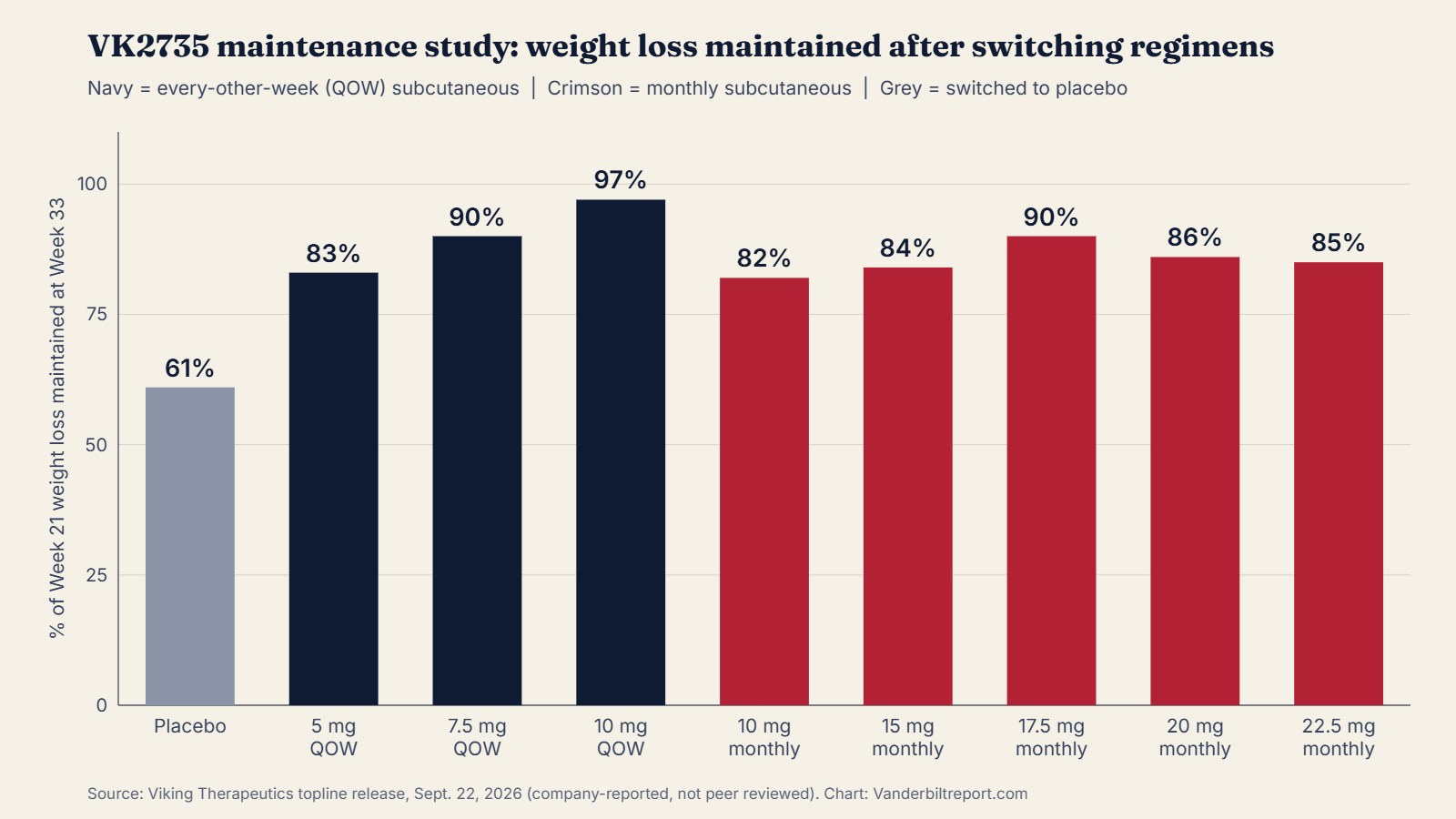
| Maintenance regimen | Patients | Weight loss maintained at Week 33 |
|---|---|---|
| Placebo | 27 | 61% |
| 5 mg every other week | 12 | 83% |
| 7.5 mg every other week | 13 | 90% |
| 10 mg every other week | 12 | 97% |
| Every other week, combined | 37 | 90% |
| 10 mg monthly | 16 | 82% |
| 15 mg monthly | 14 | 84% |
| 17.5 mg monthly | 11 | 90% |
| 20 mg monthly | 14 | 86% |
| 22.5 mg monthly | 10 | 85% |
| Monthly, combined | 65 | 85% |
Verified. Each VK2735 arm was statistically better than placebo, the company said. A small exploratory group that stayed on 17.5 mg weekly (13 patients) reached 21.7% mean weight loss at Week 33, with no plateau reported.
Safety and tolerability
Verified. During maintenance, rates of nausea, vomiting, diarrhea and constipation on VK2735 were similar to placebo, according to the release. Treatment-emergent side effects were reported in 38% of the every-other-week group and 49% of the monthly group, compared with 52% on placebo. Discontinuations due to side effects were 3% and 2%, respectively, versus none on placebo.
Verified Facts vs. Company Claims vs. Scientific Caveats
- Verified: The percentages and patient counts above are as reported by Viking in its September 22 release.
- Company statement: Viking describes the tolerability as “excellent” and says flexible dosing may improve long-term adherence. That is the company’s interpretation.
- Expert commentary: Dr. Louis Aronne, a former president of The Obesity Society who is a paid consultant to Viking, said in the release the results “provide a basis for improved dosing flexibility.”
- Scientific caveats (Analysis): The study is small. Several arms had 10 to 16 patients, and the maintenance phase lasted 12 weeks. The data are topline and have not been peer reviewed. Results do not tell us how patients would do over a year or more, and this was not a head-to-head comparison with any approved drug.
Why Maintenance Dosing Matters: The Market Opportunity
Analysis. Obesity drugs are among the largest commercial categories in the drug industry, led by Novo Nordisk’s semaglutide (Wegovy) and Eli Lilly’s tirzepatide (Zepbound). A common concern is that many patients regain weight after they stop treatment. The placebo arm in Viking’s own study, which kept 61% of its weight loss after 12 weeks, reflects that pattern.
Analysis. That makes long-term maintenance a real competitive battleground. A regimen that needs fewer injections could matter to patients, doctors and insurers, if it holds up in larger trials. Other drugmakers are working on the same problem, so Viking’s data will be measured against a moving field.
Market Reaction
Reported. Yahoo Finance reported that Viking shares rose about 27% on Tuesday after the data. Share moves reflect market sentiment on one day and are not a measure of clinical value.
Upcoming Catalysts for VK2735
These are milestones the company has disclosed. Timing can change, and Vanderbiltreport does not predict outcomes.
- Phase 3 VANQUISH program (Verified): VANQUISH-1 (about 4,500 patients) and VANQUISH-2 (about 1,000 patients) are fully enrolled, according to the Q2 report. The primary endpoint is weight change at 78 weeks.
- Oral VK2735 Phase 3 (Company statement): Viking expects to start Phase 3 for the oral tablet in the fourth quarter of 2026. Phase 2 oral data showed up to 12.2% weight loss at 13 weeks.
- Oral maintenance study (Verified): Part 2 of the current study will test oral maintenance regimens.
- Amylin program (Verified): A Phase 1 trial of VK3019, an amylin receptor agonist, began in the second quarter of 2026.
- Conferences (Company statement): Viking said it will take part in healthcare conferences in September and October 2026.
Key Risks to Watch
- Small, short maintenance study; larger and longer data are still needed.
- Phase 3 outcomes and FDA review are not guaranteed.
- High cash burn as late-stage trials continue.
- A crowded and fast-moving obesity market with large, established competitors.
The Bottom Line
Viking’s maintenance study adds early, company-reported evidence that VK2735 patients may be able to hold most of their weight loss on every-other-week or monthly injections. The findings are encouraging on their face but come from a small, short trial. The Phase 3 VANQUISH results and the planned oral Phase 3 are the milestones that will show whether the approach holds up at scale.
Sources
- Viking Therapeutics: Positive topline results from VK2735 maintenance study (Sept. 22, 2026)
- Viking Therapeutics investor relations release
- Viking Therapeutics: Second quarter 2026 financial results
- Viking Therapeutics: VANQUISH-2 enrollment complete (Mar. 26, 2026)
- Yahoo Finance: Viking shares surge after VK2735 study results
Publisher Disclaimer: Vanderbiltreport.com publishes news and information for general informational and educational purposes. Information is compiled from sources believed to be reliable, but Vanderbiltreport.com does not guarantee the accuracy, completeness, or timeliness of all information presented. Readers should independently verify information and conduct their own research before making financial, investment, business, or other decisions.