
Vuzix Corporation (NASDAQ: VUZI) has spent nearly three decades building the hardest part of smart glasses: the optics. Now the market is coming to it. AI glasses shipments are surging, display glasses are forecast to be the fastest-growing category in extended reality, a $20 million strategic investment from Quanta Computer is fully funded, Amazon is testing Vuzix’s next-generation Ultralite Pro glasses, and the company has just shipped its first waveguide samples aimed at AI data centers.
Welcome to Vanderbiltreport.com’s investor profile of Vuzix Corporation (NASDAQ: VUZI). Below you will find the business overview, market analysis, competitive analysis and a financial outlook, along with the risks that any balanced look at this story has to include. Each section opens with its key takeaways so you can scan first and read deeper where it matters to you.
Why investors are watching Vuzix: six takeaways
- A pure play on smart glasses optics: U.S.-based waveguide manufacturing in Rochester, New York, backed by more than 500 patents and patents pending.
- Blue-chip validation: Quanta Computer’s $20 million equity investment is fully funded, Amazon has expanded from M400 deployments to live testing of Ultralite Pro glasses, and a Collins Aerospace program has moved into initial production.
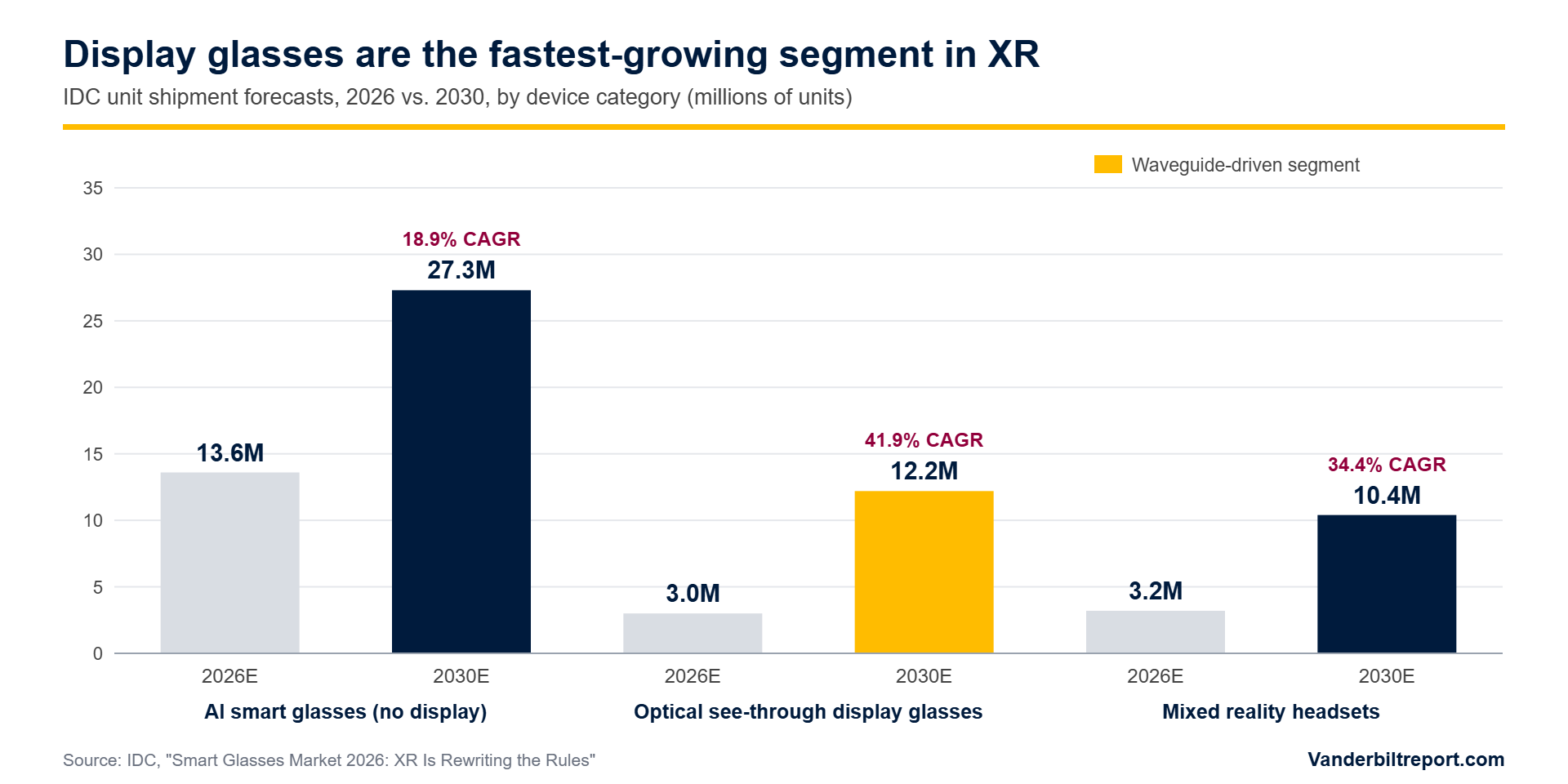
- A market in lift-off: IDC forecasts optical see-through display glasses will grow from 3.0 million units in 2026 to 12.2 million in 2030, a 41.9% compound annual growth rate.
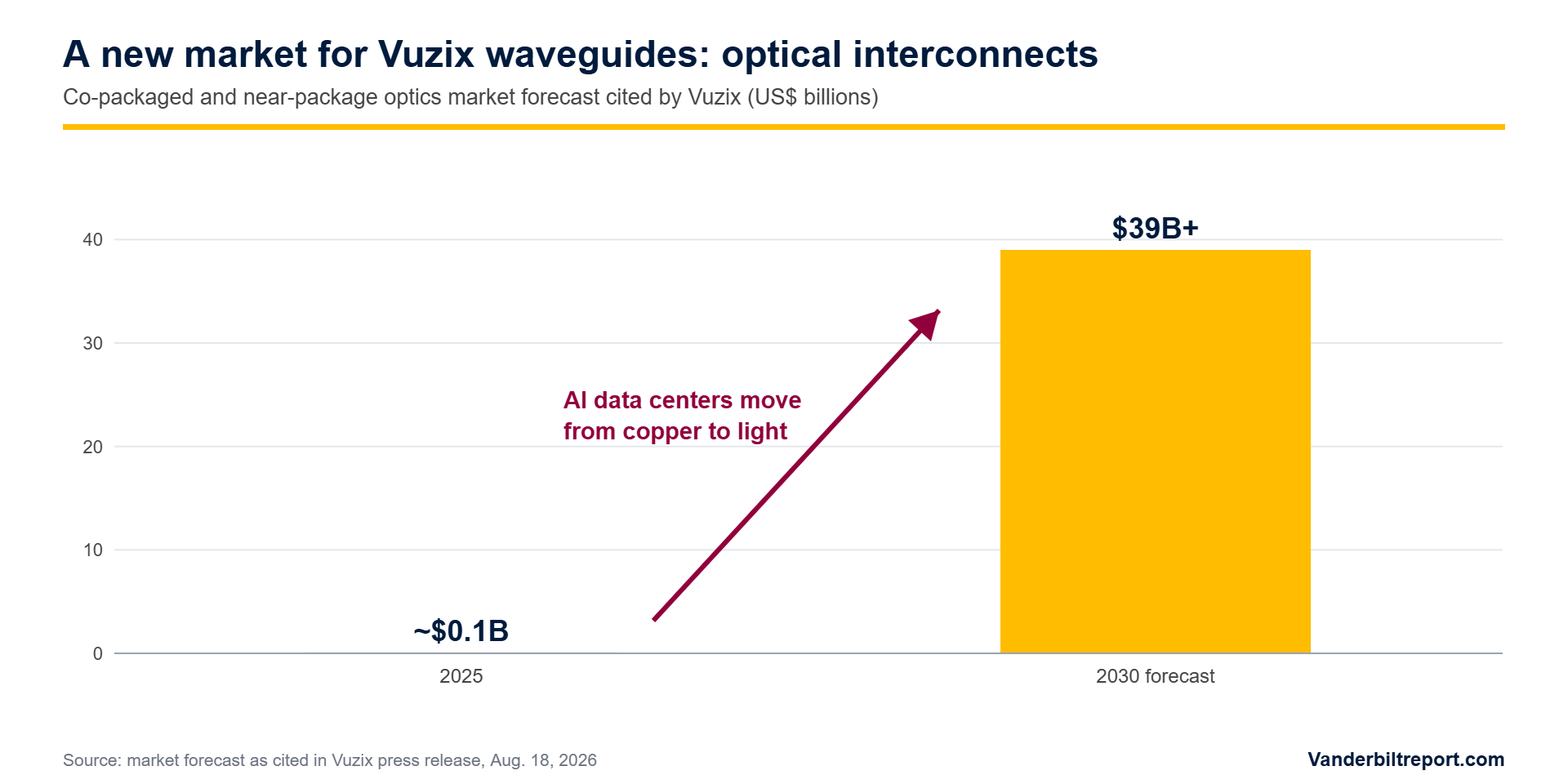
- A new frontier: in August 2026 Vuzix shipped Causeway waveguide bridge samples for optical interconnects in AI data centers, a market it cites as growing to more than $39 billion by 2030.
- A clean balance sheet: $17.3 million in cash and no debt at June 30, 2026, with net loss cut by more than half in fiscal 2025.
- Real risks: revenue is small and fell 14% in the latest quarter, operating cash burn ran $5.6 million to $6.6 million a quarter in 2026, the company funds itself partly through at-the-market share sales, and gives no revenue guidance.
Vuzix Corporation (NASDAQ: VUZI) at a glance
| Ticker / exchange | VUZI / Nasdaq |
| Headquarters | Rochester, New York, USA |
| Business | AI-powered smart glasses, waveguide optics and display engines for enterprise, defense, OEM and, most recently, AI data center customers |
| President and CEO | Paul Travers |
| Recent share price | $2.75 (close, September 18, 2026) |
| Market capitalization | About $232 million |
| 52-week range | $1.97 to $5.62 |
| Shares outstanding | About 84.4 million |
| Trailing 12-month revenue | About $5.9 million |
| Cash / debt (June 30, 2026) | $17.3 million / none |
| Intellectual property | More than 500 patents and patents pending |
Business overview: from smart glasses maker to optics platform
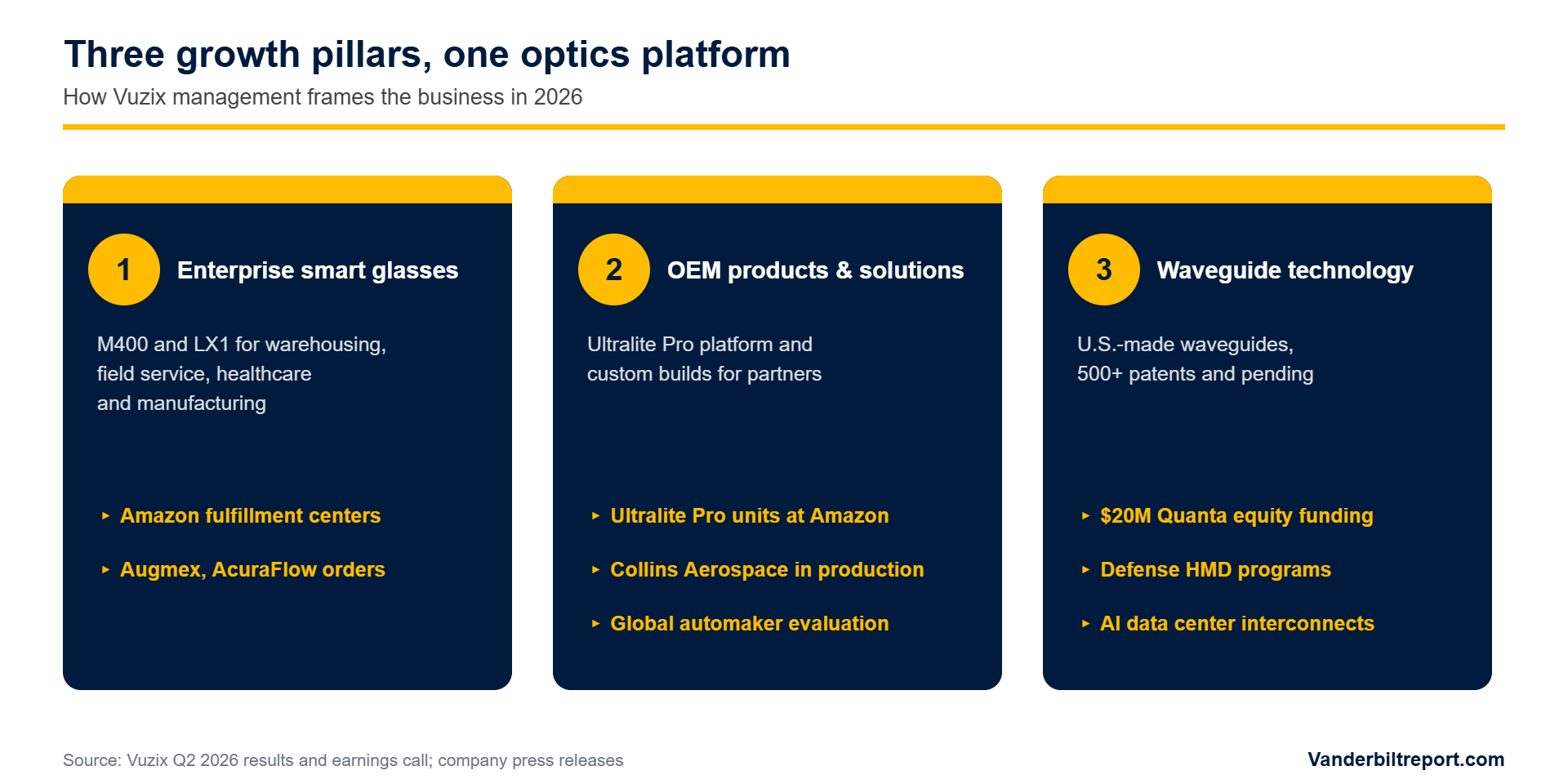
Founded in the 1990s and listed on Nasdaq, Vuzix designs and manufactures smart glasses and the see-through optics that make them possible. Its branded products, the all-purpose M400 and the rugged, freezer-rated LX1 with a 10-hour battery, are built for frontline work: warehouse picking, field service, remote expert assistance, healthcare and manufacturing inspection. Solution bundles such as a Remote Assist Kit that works with Microsoft Teams and Zoom are designed to shorten the path from pilot to rollout.
The bigger strategic story sits one layer down. Waveguides are the thin, transparent optical elements that carry an image from a tiny projector to the wearer’s eye, and they are widely regarded as the key enabling component for glasses that look and feel like ordinary eyewear. Vuzix designs and manufactures its waveguides in the United States, and says it has completed roughly a dozen custom waveguide designs over the past two years with display and optics partners including TCL, Himax, Avegant and Saphlux. Its Ultralite Pro reference platform lets OEM and ODM customers bring lightweight AI glasses to market without starting from a blank sheet.
Recent proof points
- Amazon: M400 deployments have expanded across Amazon fulfillment centers, and in the second quarter of 2026 Vuzix delivered initial next-generation Ultralite Pro glasses to Amazon for live commercial testing, including AI-driven maintenance and operations applications.
- Quanta Computer: Vuzix secured the full funding of Quanta’s $20 million equity investment by hitting agreed yield and production targets. The two companies are developing next-generation waveguides together, with a demonstration targeted for CES.
- Defense: a Collins Aerospace program for waveguide-based AR displays supporting drone applications has moved from development into initial production, with management expecting additional orders in the second half of 2026. Vuzix has also disclosed six-figure development orders from a leading U.S. defense contractor and a Tier-1 defense supplier, plus a seven-figure U.S. Department of Defense-funded waveguide program.
- Automotive: initial waveguide-based systems were delivered to a leading global automaker for factory-floor evaluation, with discussions moving toward production deployment.
- Channel partners: Augmex placed a follow-on order for M400 and LX1 glasses in August 2026 to support its U.S. launch, and AcuraFlow expanded its North American deployment in April.
Market analysis: smart glasses are having their moment
According to IDC, shipments of smart glasses without displays surged 167% year over year in the first quarter of 2026 to 2.25 million units, and the firm expects 13.6 million units for the full year, rising to 27.3 million by 2030. The more important number for Vuzix is the category IDC calls optical see-through display glasses. IDC forecasts that segment will grow from 3.0 million units in 2026 to 12.2 million in 2030, a 41.9% compound annual growth rate that makes it the fastest-growing segment in extended reality.
Every one of those display glasses needs a way to put an image in front of the eye without blocking the view, and the industry has largely converged on waveguides as the answer. That turns a consumer electronics trend into a components opportunity: a supplier does not need to win the brand war to participate in the volume.
Enterprise demand is building in parallel. Large companies are defining their AI and smart glasses strategies for frontline workers, and defense budgets are moving toward lightweight head-mounted displays for soldiers and drone operators. On the company’s first-quarter call, management said that “geopolitics is changing how defense and security agencies think about wearable technology,” a shift that favors suppliers with domestic manufacturing.
The new frontier: optical interconnects for AI data centers
On August 18, 2026, Vuzix announced that it had begun shipping Causeway waveguide bridge samples, the core of an optical interconnect evaluation kit supporting up to 19,200 parallel optical channels and compatible with microLED and VCSEL light sources. Samples went to prospective customers and partners in semiconductors, photonics and advanced packaging. The market forecast Vuzix cites sees co-packaged and near-package optics growing from roughly $100 million in 2025 to more than $39 billion by 2030 as AI clusters replace copper links with light.
This is early-stage work, and sample shipments are not revenue. But it shows that two decades of waveguide know-how may have value well beyond eyewear, and it gives investors a second way to win.
Competitive analysis: where Vuzix fits
The consumer end of the market is dominated by giants. IDC data shows Meta held 69.2% of display-less smart glasses shipments in the first quarter of 2026, with RayNeo, Xiaomi, Viture and XREAL each in the low single digits. Competing head-on for consumers would require marketing budgets Vuzix does not have. Instead, the company positions itself as an enabler and a specialist.
| Competitor group | Examples | How Vuzix differentiates |
|---|---|---|
| Consumer AI glasses brands | Meta, Xiaomi, RayNeo, XREAL, Viture | Vuzix supplies optics and OEM platforms rather than fighting for consumer shelf space, so brand growth can become component demand. |
| Waveguide and optics specialists | Lumus, DigiLens and several Asia-based suppliers | In-house U.S. manufacturing, support for LCOS, laser and microLED display engines, and Quanta as a scale manufacturing partner. |
| Enterprise wearables | RealWear and other industrial headset makers | Lightweight glasses form factors, long deployment history with logistics customers, and rugged options such as the LX1. |
| Defense display suppliers | Large defense primes and specialist optics houses | Domestic supply chain, custom waveguide design services, and active programs with Collins Aerospace and other Tier-1 contractors. |
The competitive risks are real. Larger companies can invest far more in optics, several well-funded private waveguide makers are chasing the same OEM sockets, and low-cost Asian suppliers are pushing prices down. Vuzix’s answer is to be the trusted, U.S.-based partner for customers who care about security of supply, customization and intellectual property.
Financial snapshot: small revenue, shrinking losses, no debt
| Metric | FY2024 | FY2025 | Q1 2026 | Q2 2026 |
|---|---|---|---|---|
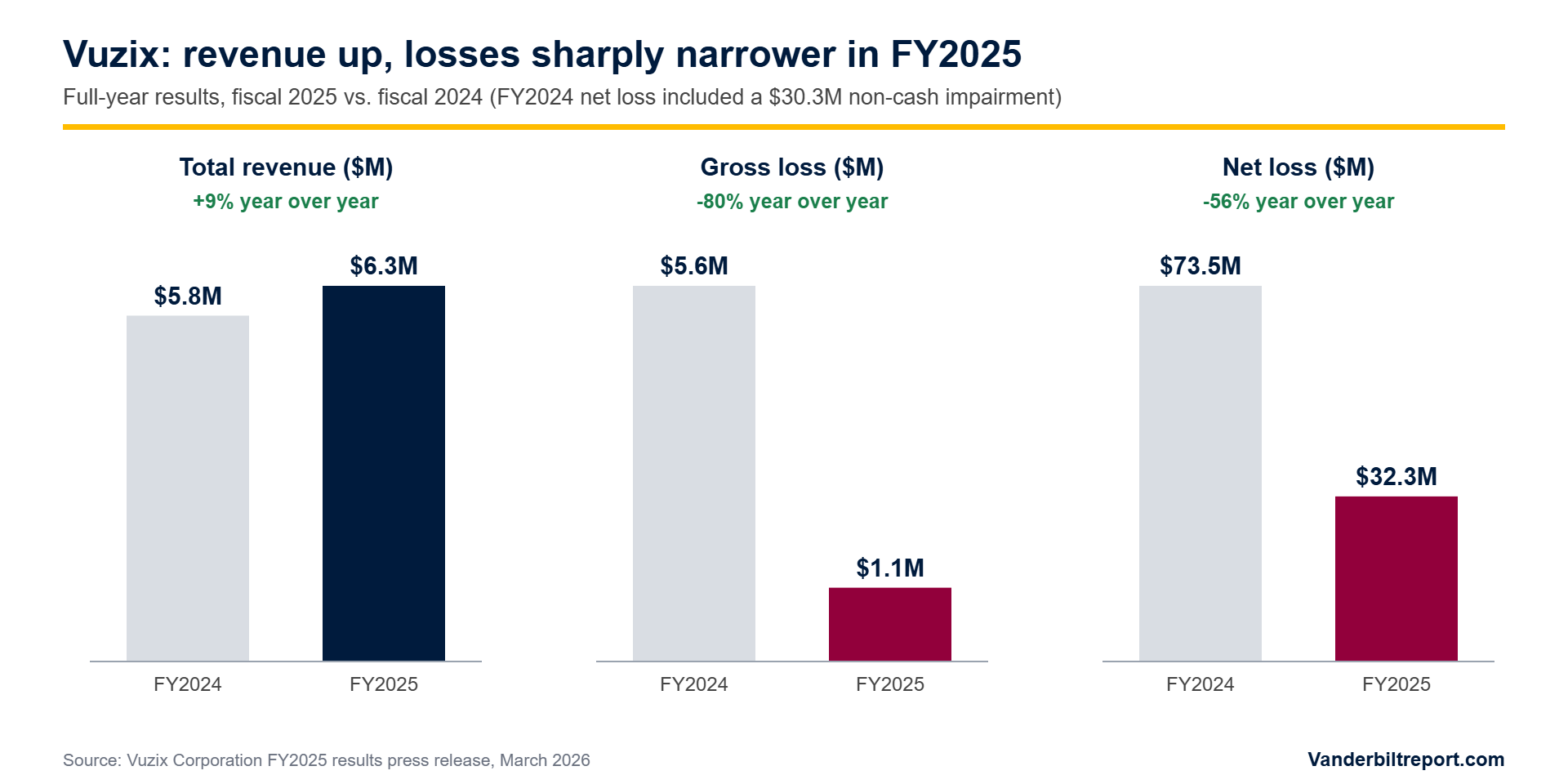
| Total revenue | $5.8M | $6.3M | $1.39M | $1.11M |
| Engineering services revenue | $1.3M | $1.6M | $0.35M | $0.23M |
| Gross profit (loss) | ($5.6M) | ($1.1M) | ($0.38M) | ($0.65M) |
| Research and development | $9.6M | $12.6M | $3.0M | $3.1M |
| Net loss | ($73.5M) | ($32.3M) | ($7.1M) | ($7.6M) |
| Net loss per share | ($1.08) | ($0.42) | ($0.09) | ($0.09) |
| Cash at period end | n/a | $21.2M | $20.2M | $17.3M |
Fiscal 2024 net loss included a $30.3 million non-cash impairment charge. Figures are rounded from company press releases.
Three things stand out. First, the cost base is being reshaped: general and administrative expense fell 46% in the first quarter of 2026, while research and development spending rose as the company invested in waveguide capacity, including $1.2 million of new manufacturing equipment in Rochester during the second quarter. Second, the balance sheet carries no debt. Third, the company is funding its build-out partly through its at-the-market equity program, which raised $5.8 million in the first quarter and $4.1 million in the second. On the first-quarter call, the chief financial officer said the company had sufficient runway to execute its operating plan well into 2027.
Financial outlook: what would have to go right
Management has said it expects the transition in product mix to drive growth over coming quarters, and points to a growing number of programs that have cleared development and validation. The milestones below are what investors should track.
| Potential catalyst | Why it matters |
|---|---|
| Amazon Ultralite Pro testing outcome | A move from live testing to volume orders would be the clearest validation of the OEM model. |
| Collins Aerospace follow-on orders | Management expects additional production orders in the second half of 2026. |
| Department of Defense-funded program | A seven-figure program would lift high-margin engineering services revenue. |
| Quanta next-generation waveguide at CES | A public demonstration with a top-tier manufacturer could draw in additional consumer-electronics OEMs. |
| Automaker production decision | Converts an evaluation into a recurring enterprise deployment. |
| Optical interconnect design wins | Feedback from Causeway sample recipients will show whether the data center opportunity is real. |
An illustrative look at the size of the prize
To give a sense of scale, consider simple arithmetic rather than a forecast. IDC expects 12.2 million optical see-through display glasses to ship in 2030. If Vuzix optics were designed into 1%, 3% or 5% of those units, and each unit carried an assumed $100 of Vuzix content, the result would be about $12 million, $37 million or $61 million of annual revenue from that one segment, compared with trailing 12-month revenue of about $5.9 million today. Defense, enterprise glasses and data center optics would sit on top of that.
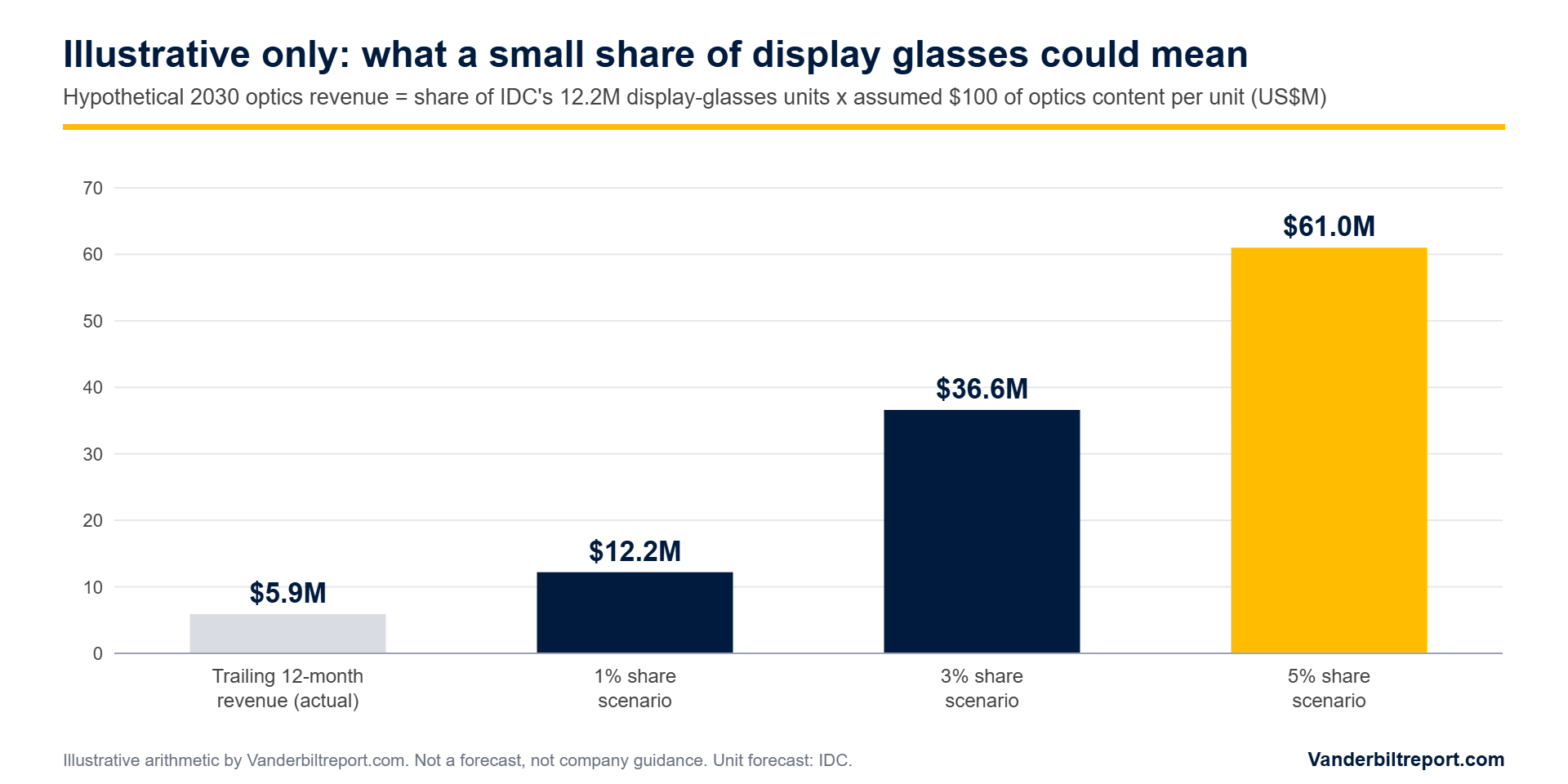
The share and content-per-unit assumptions are hypothetical and chosen by Vanderbiltreport.com for illustration. Actual results could be far lower, including no meaningful share at all.
Risks investors should weigh
- Revenue is small and currently declining: sales fell 12% in the first quarter and 14% in the second quarter of 2026 versus a year earlier, and gross margin is still negative.
- Cash burn and dilution: operating cash burn was $6.6 million in the second quarter against $17.3 million of cash. Continued use of the at-the-market program means ongoing share issuance.
- Customer concentration and timing: the thesis depends on a handful of programs, many with unnamed customers, moving into volume. Testing and evaluation do not guarantee orders.
- Competition: far larger companies and well-funded private optics specialists are targeting the same opportunity, and component prices tend to fall quickly.
- Limited analyst coverage and volatility: the stock has traded between $1.97 and $5.62 over the past year, and MarketBeat shows a consensus rating of Hold based on only two analysts, with no published price target.
- Early-stage data center effort: optical interconnects are a new market for Vuzix and have not produced revenue.
The bottom line
Vuzix is a small company positioned in front of a large wave. The smart glasses market is finally scaling, the fastest-growing part of it depends on exactly the component Vuzix has spent decades perfecting, and names like Quanta, Amazon and Collins Aerospace have already put money or programs behind the technology. With no debt, more than 500 patents and patents pending, domestic manufacturing that defense customers value, and a fresh opening in AI data center optics, the upside case is easy to see.
The other side of the ledger is just as clear: today’s revenue is modest, losses are ongoing and the path runs through share issuance until OEM programs reach volume. For investors who understand those risks and want exposure to the optics layer of AI wearables, Vuzix Corporation (NASDAQ: VUZI) is a name worth putting on the watchlist and researching further.
Frequently asked questions
What does Vuzix Corporation do?
Vuzix designs and manufactures AI-powered smart glasses, waveguide optics and display engines for enterprise, defense and OEM customers, and is developing waveguide-based optical interconnects for AI data centers.
Is Vuzix profitable?
No. Vuzix reported a net loss of $32.3 million in fiscal 2025 and $7.6 million in the second quarter of 2026.
Who are Vuzix’s major partners?
Publicly disclosed relationships include Quanta Computer, Amazon, Collins Aerospace, TCL, Himax, Avegant, Augmex and AcuraFlow.
Where does Vuzix stock trade?
Vuzix common stock trades on the Nasdaq Capital Market under the ticker VUZI.
References
- Vuzix Corporation, company website
- Vuzix Reports Second Quarter 2026 Results, August 13, 2026
- Yahoo Finance, Vuzix Q2 Earnings Call Highlights
- Vuzix Reports First Quarter 2026 Results, May 14, 2026
- The Motley Fool, Vuzix (VUZI) Q1 2026 Earnings Call Transcript
- Vuzix Reports 2025 Financial Results and Positions Waveguide and OEM Businesses for Next Phase of Smart Glasses Growth, March 2026
- Vuzix Ships High-Bandwidth Optical Interconnect Solution for AI Data Centers, August 18, 2026
- Vuzix Receives Follow-On Smart Glasses Order from Augmex, August 11, 2026
- AcuraFlow Expands Deployment of Vuzix Smart Glasses Across North America, April 30, 2026
- Vuzix Expands OEM Defense Program Base with New Six-Figure Waveguide Development Order, September 29, 2025
- IDC, Smart Glasses Market 2026: XR Is Rewriting the Rules
- StockAnalysis, Vuzix Corporation (VUZI) stock price and statistics
- MarketBeat, Vuzix (VUZI) analyst ratings
- Vuzix Corporation investor relations, press releases
Publisher Disclaimer: This article is published by Vanderbiltreport.com for general informational and educational purposes only. It is not investment advice, a recommendation, or an offer or solicitation to buy or sell any security. Information is compiled from public sources believed to be reliable, including company press releases, earnings call coverage and third-party research, but Vanderbiltreport.com does not guarantee the accuracy, completeness or timeliness of the information presented. The scenarios in this article are illustrative calculations, not forecasts or company guidance. Forward-looking statements involve risks and uncertainties, and actual results may differ materially. Small-cap securities can be volatile and investors may lose all or part of their investment. Readers should independently verify information, review the company’s filings with the U.S. Securities and Exchange Commission, and consult a licensed financial professional before making any investment decision. Vuzix, M400, LX1 and Ultralite are trademarks of Vuzix Corporation; all other trademarks belong to their respective owners.