


THE VANDERBILT REPORT | ARTL
THE VANDERBILT REPORT
EQUITY RESEARCH & INVESTOR INTELLIGENCE
NASDAQ: ARTL | SEPTEMBER 2026 | CLINICAL-STAGE PHARMACEUTICALS
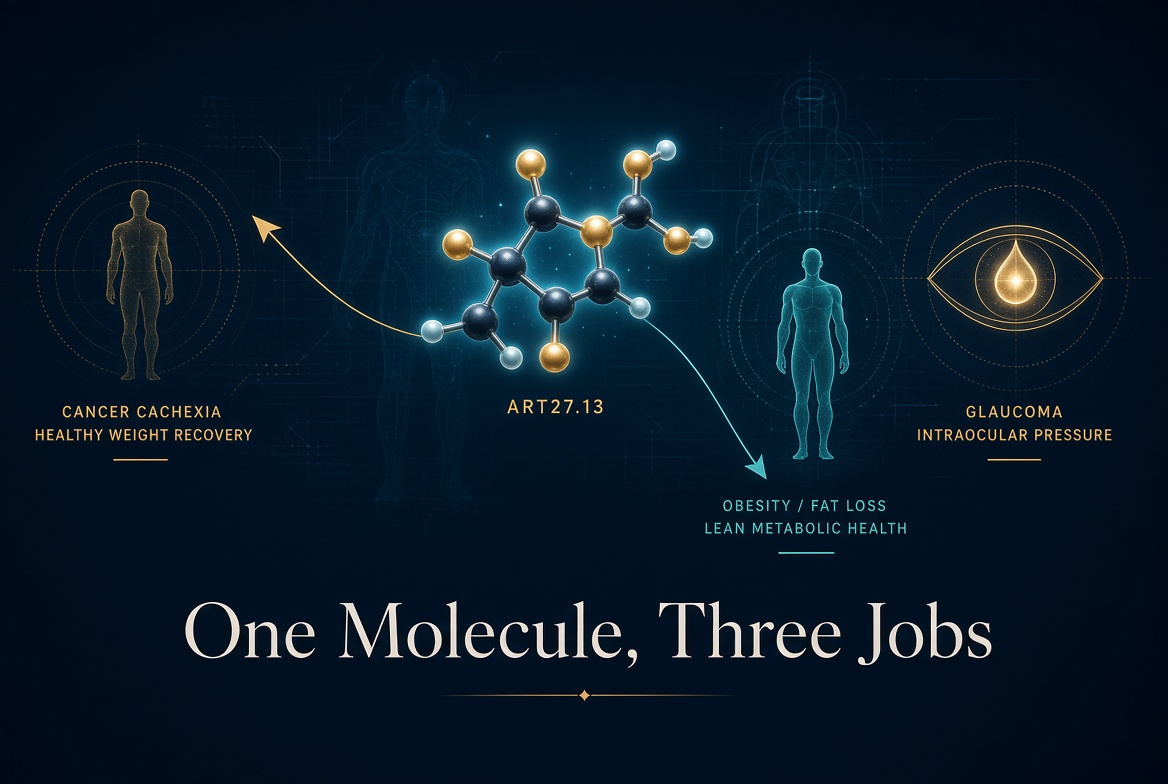
Artelo Biosciences: One Molecule, Three Jobs
Why ART27.13 Is Worth Understanding Before the Market Prices It
A clinical-stage cannabinoid pharmaceutical company with a peripherally selective drug candidate that gained weight in cancer patients, lost weight in obese mice, and did neither in lean ones — and what that combination might be worth.
AT A GLANCE
40% WEIGHT LOSS — ART27.13 + SEMAGLUTIDE COMBO (MOUSE MODEL) | 2041 PATENT PROTECTION RUNWAY — US, EU, JAPAN | +6% WEIGHT GAIN VS. −5% PLACEBO — CARES PHASE 2 INTERIM (HUMAN) | 300+ PARTICIPANTS ACROSS ART27.13'S PRIOR CLINICAL STUDIES |
Weight-loss figures are nonclinical (mouse model) and have not been tested in humans; CAReS figures are interim, small-n Phase 2 human data. See disclosures at the end of this report.
THE ONE-PARAGRAPH THESIS
Artelo Biosciences owns full global rights to a drug that pushes body weight in whichever direction the patient needs — up in cancer patients with cachexia, down in obese mice, unchanged in lean ones. That's not a simple appetite switch. It's the kind of signal that gets pharmaceutical business-development teams paying closer attention. The same molecule is already dosing patients in a funded human glaucoma study. Artelo is a lean, seven-person company with a sub-$3 million market cap sitting on a multi-indication clinical asset and a freshly reinforced balance sheet. The obesity data is early and nonclinical — and worth understanding before the market catches up.
TEACHING THE SCIENCE: WHY AN AGONIST ISN'T THE OLD CANNABINOID STORY
Cannabinoid drug development has a bad reputation with investors, and it's earned. The first wave of CB1-targeted drugs in the 2000s blocked the receptor system-wide — rimonabant, the best-known example, produced real weight loss and was pulled from European markets after being linked to depression and suicidal ideation. That history is why "CB1" still makes biotech investors flinch.
ART27.13 breaks that pattern. For more than two decades, the industry's approach to CB1 and body weight has run one direction: block the receptor. Full agonists — molecules that activate rather than shut it down — have largely been avoided, in part because of rimonabant's legacy. ART27.13 is a potent agonist of both CB1 and CB2, engineered to act in peripheral tissue while minimizing brain exposure — the design choice that sidesteps rimonabant's psychiatric liability. Producing meaningful weight and fat loss in obese animals through that mechanism is, by the Company's own account, a genuinely differentiated result in the field — not an incremental tweak on the old approach.
Researchers describe this as a "state-dependent metabolic regulator" — a compound that nudges weight in different directions depending on the body's starting state. That's the scientific thread connecting Artelo's three programs. It's a hypothesis, not a settled fact. But it's the reason a company this small has three legitimate clinical stories running at once instead of one.
THREE JOBS FOR ONE MOLECULE
1. Cancer anorexia-cachexia (the human data). This is where ART27.13 has actual clinical evidence in patients. In the Phase 2 CAReS trial, patients treated at the 1,300 µg dose for 12 weeks gained an average of 6.38% body weight, against a 5.42% loss in the placebo arm — a roughly 12-point swing on a condition with no FDA-approved pharmacological treatment. The dataset is small and interim, and it still needs to be replicated at scale. But it's real human data, not a model.
2. Obesity and GLP-1 combination potential (nonclinical — mouse data, not human data). The Company's DIO-2 study replicates and extends an earlier DIO-1 pilot, using the diet-induced obesity model that's the industry standard for evaluating GLP-1 drugs. Obese mice spent 15 weeks on a high-fat diet before treatment began, matched to the same strain as the lean controls to rule out genetics as a confound. ART27.13 monotherapy cut body weight by roughly 20% over four weeks — matching semaglutide's curve, with no statistically significant difference between the two. Combined, the pairing produced roughly 40% weight loss: double either agent alone, and a result the Company reports was statistically distinct from semaglutide alone, not just numerically larger.

Source: Artelo Biosciences, non-clinical DIO study data on file, Sept. 2026.
The full 28-day course behind that number tells the same story, week by week:

Body weight change by treatment arm, DIO-2 study (28-day). SC = standard chow (lean); HFD = high-fat diet (obese). Source: Artelo Biosciences, data on file, Sept. 2026.
The combination arm didn't just lose more weight — it landed at the body weight of the lean, healthy control animals, erasing the obesity phenotype in four weeks. The type of weight lost mattered just as much: roughly 80% of the weight lost on ART27.13, alone or combined, was fat mass, versus roughly 70% for semaglutide alone. The combination group's body composition normalized furthest toward the lean-control ratio of any arm in the study.

Source: Artelo Biosciences, non-clinical DIO study data on file, Sept. 2026.
Looked at simply as fat lost versus lean mass lost, the split is starker still:

Source: Artelo Biosciences, non-clinical DIO study data on file, Sept. 2026.
In lean, standard-diet mice, ART27.13 produced no meaningful change in body weight, fat, or lean mass — the selectivity that makes the "state-dependent metabolic regulator" framing more than a marketing phrase. Appetite tells a related story: both monotherapies suppressed food intake for the first one to two weeks, then recovered toward baseline even as the lower body weight held. The combination suppressed appetite harder, and for longer, than semaglutide alone.

Body weight (left axis) and food consumption (right axis), semaglutide vs. ART27.13 monotherapy. Source: Artelo Biosciences, data on file, Sept. 2026.
None of this is human efficacy data, and mouse results in metabolic disease frequently do not translate. No human obesity trial is underway. Readers should not treat this as evidence Artelo is launching an obesity drug.
BEYOND THE HEADLINE NUMBERS: WHAT ELSE DIO-2 SHOWED
The topline weight and fat-loss figures are the easiest numbers to headline. But the fuller DIO-2 dataset — which the Company has made available for editorial reference — includes secondary findings that speak to the mechanism's breadth, not just its size:
— Liver hypertrophy was fully reversed in every treatment arm, monotherapy or combination — a marker of reduced fatty liver burden associated with diet-induced obesity.
— Cholesterol improved across the board. Both semaglutide and ART27.13 reduced total cholesterol, HDL, and LDL to similar degrees as monotherapies — and further still in combination.
— Glucose tolerance improved further in the combination arm than with semaglutide alone, measured by an oral glucose tolerance test — a marker directly relevant to the type 2 diabetes comorbidities common in obesity.
— Bone mineral density increased only in the combination group — not in either monotherapy alone. That's a real point of differentiation: GLP-1 therapy has drawn scrutiny over bone density loss during rapid weight loss. A combination that adds bone density instead of risking it would be a genuinely distinctive profile, if it holds up.
Independent, peer-reviewed literature from outside labs shows the same pattern with THC and other cannabinoid receptor agonists — weight loss in obese animals, weight gain in wasting conditions, no effect in normal-weight animals. The DIO-2 dataset extends that biological pattern to a clinical-stage, orally dosed small molecule with human safety data already in hand. Every point above remains nonclinical and preliminary. The value is in the breadth and consistency of the signal, not any single number.
3. Glaucoma (human study, third-party funded). The same molecule is in DREAM, a Phase 2 study testing whether oral, once-daily ART27.13 can lower intraocular pressure. First patient dosed August 10, 2026, at 650 µg. The trial is funded by Glaucoma UK and the HSC R&D Division — not Artelo's own cash. For a company this size, that's the more important fact than the medical one: it's a second indication that doesn't touch the balance sheet.
IN THEIR OWN WORDS
Three members of Artelo's leadership spoke to the obesity data directly in the Company's September 16, 2026 release. Their comments are worth reading in full context, not just headline fragments:
Andrew Yates, Ph.D., Chief Scientific Officer
On why an agonist producing weight loss runs against two decades of industry assumption:
"The prevailing dogma has been that CB1 antagonism is required for weight loss, so observing semaglutide-like weight loss with a cannabinoid receptor agonist is striking. What makes these data especially compelling is the selectivity — in obese animals, ART27.13 drove substantial fat loss and improved body composition, while in lean animals there was no observed effect on weight, appetite, or body composition. That is precisely the profile one would want in an obesity therapeutic."
Prof. Saoirse O'Sullivan, Ph.D., Vice President of Translational Science
On how the data connects across Artelo's two human-facing programs:
"The consistency of these results across the initial pilot study and the follow-on study — in every measure we examined — is what gives us confidence in the signal. The doubling of weight loss in combination with semaglutide suggests ART27.13 may work through a mechanism that is complementary to, rather than overlapping with, GLP-1 receptor agonism. We believe the clinical and nonclinical data suggest ART27.13 may act as a peripheral metabolic regulator, promoting weight gain in a wasting state and weight loss in an obese state."
Gregory Gorgas, President and Chief Executive Officer
On how a muscle-protection question turned into a broader finding:
"We set out to answer a narrow question — whether ART27.13 could help protect muscle in patients taking GLP-1 medicines — and the study provided insight for a much bigger one. In the context of a global GLP-1 market that J.P. Morgan has projected could reach $200 billion by 2030, we believe these results warrant further investigation. This new data is expected to open up new partnering conversations with pharmaceutical companies active in metabolic disease."
POSITIONING: A PARTNERING COMPANY, NOT AN OBESITY LAUNCH STORY
This is the single easiest place for enthusiasm to run ahead of the facts, so it bears repeating: Artelo is not commercializing an obesity drug. Seven employees. No Phase 2 or later obesity trial underway. A market cap in the low single-digit millions. What it has is optionality — a human proof point in one indication, an externally funded shot on goal in a second, and now a nonclinical signal opening the door to a third, much larger category. Think of ART27.13's obesity angle as a business-development asset, not a pipeline stage. A GLP-1 developer looking for a combination partner that protects lean mass and adds fat loss has a reason to pick up the phone. That's a different thing from Artelo running its own obesity trial, and this report isn't claiming the latter.
VALUE IN THREE LAYERS
What you're actually being asked to value here are three different kinds of assets, stacked on top of each other.
Layer one: the balance sheet, stabilized. Cash at year-end 2025 was just $0.6 million. Management moved on that directly: a roughly $11 million gross raise in March 2026 brought cash to $4.2 million as of June 30, 2026, against $1.5 million in total liabilities and $5.0 million in total equity — materially stronger than six months earlier. Q2 net loss was $2.4 million and H1 losses totaled $5.4 million, so the current cash bought real runway, not permanent security. The standing equity line gives management a ready mechanism to extend that runway as trial data continues to read out.
Layer two: human trials actually running. This isn't a paper pipeline. CAReS is enrolling with interim human data already presented. DREAM has dosed its first glaucoma patient. ART26.12, Artelo's second clinical compound, has completed its first-in-human study. ART12.11 has a path to Phase 1 cleared by the UK's MHRA. Three distinct assets, human studies underway or completed on two of them — more clinical activity than the market cap implies.
Layer three: the metabolic option. The newest, least-proven, highest-optionality layer — the nonclinical GLP-1 combination data. It costs Artelo little to keep exploring, and it opens doors to a category of partner — large-cap obesity and metabolic drug developers — that a small cannabinoid-focused biotech wouldn't otherwise reach. It's worth exactly what an unproven nonclinical signal is worth: a call option, not a valuation input.
A WORD ON SHARE STRUCTURE
Artelo completed a 1-for-9 reverse stock split, effective for trading August 31, 2026, bringing shares outstanding to approximately 547,774. Reverse splits reset share count without changing the value of the underlying business. Small-caps commonly use them to maintain listing compliance while continuing to fund development through equity issuance — and that access to capital is precisely what has funded this year's pipeline expansion, including the DIO-2 work now opening a third conversation for the Company. The March 2026 raise and standing equity line are the mechanisms carrying that forward. Investors should factor continued equity funding into how they size a position, the same way they would with any capital-intensive clinical-stage company.
PEER CONTRAST: THE CB1 LANDSCAPE WIDENS
The more informative comparison for ART27.13's obesity signal isn't a company in an unrelated therapeutic area. It's Corbus Pharmaceuticals (NASDAQ: CRBP) — targeting the same receptor system, in the same disease, from the opposite pharmacological direction. ART27.13 is a CB1/CB2 agonist. Corbus's lead obesity candidate, CRB-913, is a peripherally restricted CB1 inverse agonist — mechanistically closer to rimonabant, engineered to stay out of the brain (Corbus has disclosed 21-fold lower brain exposure than rimonabant at an equivalent dose). Two companies, opposite pharmacology, the same target and the same disease. That's a far more useful yardstick than market cap alone.
Corbus is meaningfully ahead on clinical proof of concept, and that needs to be said plainly before anything else. On September 14, 2026, Corbus announced positive topline data from CANYON-1, a 16-week Phase 1b study of CRB-913 in 254 obese, non-diabetic adults. Actual human dosing, not a mouse model — monotherapy only, no GLP-1 combination arm. The 60 mg dose produced a statistically significant, clinically meaningful 5% mean weight loss at 12 weeks, with no plateau observed, alongside a safety and GI-tolerability profile the Company describes as more favorable than oral GLP-1 drugs. The data was selected for a late-breaking presentation at ObesityWeek 2026, and CRBP shares moved higher on the news. Artelo has no comparable human obesity data of its own. Its obesity signal remains entirely preclinical.
Corbus isn't the only company betting on this receptor system, and the wider field cuts both ways for Artelo. Novo Nordisk — the maker of Ozempic and Wegovy, and the largest commercial force in obesity — acquired Inversago Pharma for its own CB1 inverse agonist, monlunabant, and published Phase 2a results in The Lancet Diabetes & Endocrinology in September 2025 showing statistically significant weight loss in patients with obesity and metabolic syndrome. A company with Novo Nordisk's resources betting on CB1 modulation is itself a validation of the pathway. But the independent commentary on that same publication is worth citing directly: reviewers noted monlunabant's psychiatric adverse events were "similar to those seen with centrally acting CB1 antagonists whose development was terminated" — a direct callback to the rimonabant problem this entire drug class exists to solve, and a sign that peripheral restriction hasn't fully closed the question for every inverse agonist in development. Corbus reports a cleaner profile for CRB-913 specifically, describing its psychiatric adverse events as "broadly in line with GLP-1 drugs" — self-reported, not yet independently reviewed, but a genuinely different early result within the same mechanistic subclass.
Where Artelo compares favorably is preclinical efficacy magnitude — with real caveats attached. In Corbus's own published diet-induced-obesity mouse data, CRB-913 monotherapy produced roughly 10% to 19% weight loss at Day 18 (2.5 and 5 mg/kg) — broadly in the range Artelo has reported for ART27.13 monotherapy, ~20% at Day 28. In combination with semaglutide, Corbus's disclosed result was roughly 24% (CRB-913 2.5 mg/kg + semaglutide 30 nmol/kg); paired with tirzepatide instead, Corbus's strongest combination reached roughly 33%. Artelo's ART27.13 combined with semaglutide (20 nmol/kg) reached roughly 40% over 28 days. This isn't apples-to-apples: Corbus's study ran 18 days against Artelo's 28, the compounds are dosed in different units (mg/kg oral small molecule vs. µmol/kg), and neither company's mouse data has yet been confirmed to translate the way Corbus's just did in the clinic. But at face value, by percentage points alone, ART27.13's nonclinical numbers look comparable to, or larger than, Corbus's in the same disease model.
The more precise way to frame ART27.13's position, then: not a smaller competitor chasing two better-funded CB1 programs, but a mechanistically distinct third path. Both Corbus and Novo Nordisk are blocking the receptor. ART27.13 activates it. Whether that distinction ultimately matters for tolerability is a genuinely open question — Artelo has no human obesity safety data of its own yet, and this is not a claim that agonism is safer, only that it's a different mechanism than the one drawing psychiatric-AE scrutiny in this class. Combination readiness is worth noting too: Corbus's human data to date is monotherapy only, and combining CRB-913 with GLP-1 therapy is something the Company describes as still "evaluating," not testing. Artelo's DIO-2 combination data already exists. And when ART27.13 eventually enters human obesity testing, it won't start cold on safety — the compound already carries roughly seven prior clinical studies and 300 participants of human experience from its AstraZeneca-origin development, a base neither monlunabant nor CRB-913 had at this stage of their own programs.
None of this is bragging rights over ten extra days of mouse dosing. It's valuation context. Corbus entered September with a market cap of roughly $200 million — more than 70 times Artelo's — even before this month's positive human readout pushed shares higher still. That gap exists because Corbus already cleared the step Artelo hasn't yet attempted: dosing its CB1-pathway obesity candidate in actual patients. Between a company with Novo Nordisk's resources and a $200 million-plus microcap, the CB1 pathway has already absorbed a scale of capital and clinical effort that dwarfs anything Artelo has spent to get into this conversation. This is not a prediction that Artelo's nonclinical signal follows the same trajectory once it reaches the clinic — that remains genuinely unproven, and mouse data frequently fails to translate. But it's a real, current data point on what the market has just shown it will pay for a positive human obesity readout out of this receptor class — the honest yardstick against which Artelo's next steps in this indication should be measured.
THE REST OF THE PIPELINE, ON ONE SCREEN
The DIO-2 data didn't just add a data point. It added a third program to a pipeline that was already carrying two others toward the clinic. Here's the full picture:
COMPOUND | MECHANISM / STATUS |
ART27.13 | Peripheral CB1/CB2 agonist. Phase 2 CAReS (cancer cachexia, human data positive/interim); Phase 2 DREAM study dosing (glaucoma, third-party funded); nonclinical obesity/GLP-1 combination signal. Formulation patents allowed in the US, Europe, and Japan, with protection extending toward 2041. |
ART26.12 | FABP5 inhibitor. First-in-human study completed with a clean safety profile; positioned for chemotherapy-induced peripheral neuropathy. |
ART12.11 | Proprietary CBD/tetramethylpyrazine cocrystal. UK MHRA has cleared a streamlined path to Phase 1. |
Origin | ART27.13 was originally developed by AstraZeneca and had already been through approximately seven clinical studies involving roughly 300 participants before Artelo licensed it — a pedigree that matters when evaluating the compound's underlying safety record. |
WHAT THE DIO-2 DATA ACTUALLY ADDS
Strip away the ticker-chasing and the DIO-2 data is a genuine accomplishment for a seven-person company. It took a molecule already generating positive human signal in one disease, and a funded trial in another, and produced a mechanistically consistent, internally replicated nonclinical signal in a third — one that happens to sit inside the largest, fastest-growing category in pharma. J.P. Morgan has projected the global GLP-1/obesity drug market could approach $200 billion by 2030 — a third-party projection, not an Artelo estimate, cited here only to size the category this data now gives the Company a seat at the table for.
None of that requires inflating what the data is. The mouse data is a research signal — not a human result, a sales figure, or a preview of an FDA decision. No obesity trial in humans exists yet, and no FDA approval exists for cancer cachexia or obesity. Clinical development is a multi-year, multi-trial process, and Artelo will continue to need outside capital along the way — standard conditions for a company at this stage. The accomplishment is real. So is the distance still ahead of it.
WHAT TO WATCH
Obesity/GLP-1 is now a live third conversation. Here's what turns this quarter's data into next year's partnering leverage:
— Further CAReS enrollment and any additional interim data presentations through 2026
— DREAM study (glaucoma) enrollment progress at the Northern Ireland Clinical Trials Unit
— Whether the nonclinical obesity/GLP-1 data draws any disclosed partnering interest
— ART26.12's progression into multiple ascending dose study
— ART12.11's Phase 1 initiation under the MHRA-cleared pathway
— Cash runway updates and any further financing activity, given the current burn rate against a $4.2M cash position
CLOSE
Artelo just did something uncommon for a company its size: it took one owned molecule and, without diluting focus or starting from scratch, extended it into a third major disease category on the strength of internally consistent, replicated data. This is not a story about a company about to sell weight-loss drugs. It's a story about a lean, disciplined clinical-stage biotech that owns full global rights to a molecule now showing up in three separate conversations — cancer cachexia, glaucoma, and, provisionally, metabolic disease — at a market cap that doesn't yet appear to price in any of the three, let alone all of them. The nonclinical obesity data is early. It will need to be replicated further and eventually tested in humans before it means anything commercially, and continued financing remains part of the plan. What makes this worth tracking is the combination already in hand: real human data in one indication, a third-party-funded trial running in a second, and a credible, well-grounded reason for a much larger industry to start paying attention to a third.
DISCLOSURE
The Vanderbilt Report is a financial communications and investor relations firm. This report has been prepared for informational purposes only and does not constitute investment advice, a solicitation, or an offer to buy or sell any security. The Vanderbilt Report may have been compensated for the production of this content. Readers should conduct their own due diligence and consult a licensed financial advisor before making any investment decisions. Investing in clinical-stage biopharmaceutical and microcap securities involves a high degree of risk, including potential loss of principal. Past performance is not indicative of future results. Nonclinical (animal) data discussed in this report may not translate to human outcomes; no product discussed is FDA-approved for cancer cachexia, obesity, or glaucoma. Ozempic and Wegovy are registered trademarks of Novo Nordisk A/S; Artelo Biosciences is not affiliated with, sponsored by, or endorsed by Novo Nordisk. This report contains forward-looking statements based on currently available information, and actual results may differ materially.
FORWARD-LOOKING STATEMENTS
This report contains forward-looking statements within the meaning of Section 27A of the Securities Act of 1933 and Section 21E of the Securities Exchange Act of 1934. These statements involve known and unknown risks, uncertainties, and other factors that may cause Artelo Biosciences' actual results, performance, or achievements to be materially different from any future results, performances, or achievements expressed or implied by the forward-looking statements, including statements regarding clinical trial outcomes, capital needs, and potential partnering activity. Artelo cautions investors not to place undue reliance on these forward-looking statements, which speak only as of the date of this report. The Company undertakes no obligation to update any forward-looking statements.
www.vanderbiltreport.com
— Page