




On August 20, NextTrip, Inc. (NASDAQ: NTRP) launched NextTrip Pro, a new B2B travel platform built around a premise that runs counter to one of the travel industry’s longest-running predictions: technology isn’t eliminating the travel advisor, it’s changing what the advisor can do.
NextTrip Pro brings together digital marketing and customer engagement, booking technology, group travel capabilities, rewards and Agentic AI within a unified platform designed to help travel advisors and agencies attract customers, work more efficiently and convert travel inspiration into bookings, while keeping their existing brands, affiliations and client relationships intact.
Helping shape the technology behind that strategy is NextTrip Chief Technology Officer Brad Buice, whose perspective comes from nearly three decades spent building and modernizing technology for the travel industry and the advisors who sell it.
Long before generative AI became the industry’s newest disruption story, Buice worked on the infrastructure connecting travel professionals with inventory, suppliers and customers. His career has included leadership roles with Trisept Solutions, Apple Leisure Group and Hyatt, as well as earlier experience with Sabre. At Trisept, he was closely involved with the evolution of VAX VacationAccess, the leisure travel marketplace that has connected more than 100,000 travel advisors with over 50 travel suppliers.
That history gives Buice an unusually long view of today’s AI debate. He has watched technology repeatedly transform how travel is researched, marketed and booked, while the professional advisor has continued to evolve alongside it.
Now, with NextTrip Pro, Buice is applying those lessons to a new generation of technology: one in which AI is intended not to replace the advisor, but to give the advisor greater speed, intelligence and digital capability while preserving the human expertise and trusted relationships that remain difficult to automate.
Every few years, a new tool arrives and someone declares the travel advisor obsolete. Online booking engines were supposed to end them. Mobile apps were supposed to finish the job. Now generative AI is cast in the same role.
We looked at the filings and the field data around NextTrip, Inc (NTRP) and its CTO, Brad Buice, because his read on this moment runs against the common script. The numbers back him up.
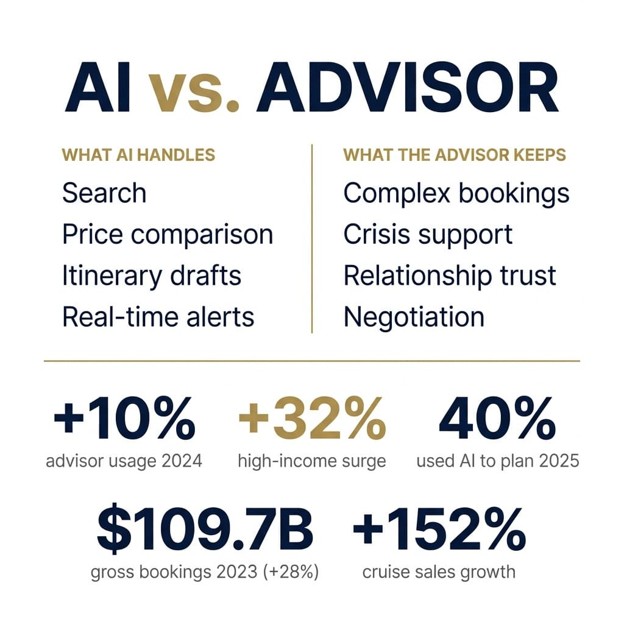
Travelers used advisors 10% more in 2024, and high-income brackets increased usage by 32%, according to advisor demand research. The people closest to the money are leaning harder on human help, not less.
The Constant Underneath the Churn
Buice has spent years close to a craft-driven workforce, and he came away respecting their dedication. That perspective shapes his entire technology strategy.
His method is simple to describe. Sort the market into what has become a commodity and what still commands a premium. Then build only for the premium.
Booking a single flight is a commodity. A machine handles it well. Assembling a complex, multi-destination luxury trip is a different problem, and the market pays for that difference.
Deloitte research shows demand for advisors runs as high as 85%, driven by expert curation of complex trips rather than simple bookings. The most-cited factor that makes a luxury trip worth it is exceptional service at 38%, per luxury travel analysis.
The value sits in the parts a machine cannot hold. Firsthand experience of a place. A relationship built on trust over years of trips.
The Business Outcome, Not the Capability
Buice judges technology by what it produces, not by what it demonstrates. That discipline matters most when the whole industry is chasing the same headlines.
The test he applies: does this tool raise the human expert to meet the standard the customer’s own tools have already set?
Consumers now arrive prepared. In 2025, 40% of travelers worldwide used AI tools to plan a trip, according to agentic AI reporting. A client who spent an evening with an AI planner expects their advisor to match that speed and depth.
This is where agentic AI earns its place. These systems make autonomous decisions guided by goals, context, and feedback, per Tredence analysis. In NextTrip’s platform Buice is building, the machine assembles the itinerary. The advisor spends their time on the parts that convert.
Technology earns its place when it raises the human expert to meet the expectations the customer’s tools have already created.
Building the Platform to Serve the Advisor
The question Buice keeps asking is who the system is built to serve. Then he checks whether the incentives point at that person or past them.
Many industry platforms optimize for the transaction. NextTrip’s approach optimizes for the advisor. Information, training, and community come first, and the transaction follows from that.
The market data supports the choice. U.S. travel agency gross bookings surged 28% to $109.7 billion in 2023, per Phocuswright, with continued growth projected. The Bureau of Labor Statistics projects 20% career growth for advisors through 2031.
Advisors serve a demographic that pays for expertise. Around 76% of advisor clients are over 40, and 60% earn $100,000 or more, according to industry survey data.
What the AI Handles
- Itinerary assembly across multiple destinations
- Routine execution that once consumed advisor hours
- Matching the research depth clients now bring to the table
What the Advisor Keeps
- Firsthand knowledge of a property or region
- The trusted relationship that closes the sale
- Experience design and supplier partnerships
With AI handling routine work, agencies redirect human teams toward partnerships and experience design, and scale service without adding headcount, per travel operations research.
The Media and Travel Convergence
NextTrip’s larger bet joins media and travel in one ecosystem. Content inspires the traveler. The platform gives advisors the tools to turn that inspiration into a booking.
The gap here is real. Nearly 76% of consumers value professional support when planning a trip, even when they ultimately book online, per travel agency statistics.
Whoever holds both the inspiration and the transaction captures the full journey. That is the competitive position NextTrip and Buice are building toward.
The Discipline of Rapid Growth
NextTrip has grown through acquisitions, and that creates a familiar trap. Many assets get stitched together fast, and the temptation is to make the technology do everything.
Buice resists that. He picks the few things the combined whole must accomplish and builds for those. The rest waits.
The failure mode for technology leaders in this position is chasing every capability to impress stakeholders. Buice measures against business outcomes and lets that filter the roadmap.
What This Means for the Market
The lesson reaches past travel. In any service craft where firsthand experience and client trust separate the professional from the machine, automation moves the human’s value upward rather than erasing it.
Cruise sales rose 152% in 2023, with travel agencies handling two-thirds of all bookings, per Phocuswright data. The most complex categories stay firmly in human hands.
For investors watching NTRP, the thesis is clear. The company builds tools that lift advisors rather than route around them, and the data on advisor demand, luxury spending, and career growth points the same direction.
The relationship and the lived experience are what still convert. Technology’s job is to raise the human to meet that standard. That is the constant Buice found underneath decades of churn, and it is the bet he has placed again at NextTrip.