




By the Vanderbilt Report Markets Desk
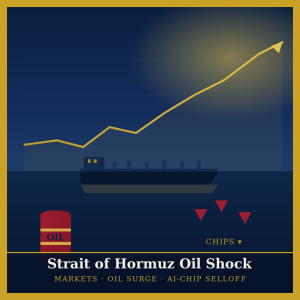
Welcome back, readers — there is a lot moving on the tape this week, and we are here to walk you through it calmly. A fresh Strait of Hormuz oil shock has pushed crude prices sharply higher and reintroduced geopolitical risk to portfolios that had, until recently, been pricing in a smooth path ahead. At the same time, a separate wave of selling in semiconductor and AI-linked names dragged the Nasdaq lower, leaving investors juggling two very different stories at once. Below, we break down what happened, why it matters, and what to watch next.
How the Strait of Hormuz Oil Shock Unfolded
The catalyst was a return of hostilities around one of the world’s most important waterways. The Strait of Hormuz typically handles roughly 20% of the world’s oil traffic, so any threat to transit reverberates quickly through energy markets. After Iran was reported to have struck a Qatari liquefied natural gas tanker near the strait, benchmark crude jumped. Brent settled about 3% higher at $74.16 a barrel and US West Texas Intermediate advanced to roughly $70.44, according to CNBC.
Prices then extended their climb after the US Treasury Department moved to revoke the license permitting Iranian oil sales — a policy shift that tightened the supply picture and sent Brent above $76 and WTI above $72 in later trading. A US-led naval coalition, the Joint Maritime Information Center, raised its threat assessment for ships crossing the strait to “severe.” The escalation underscored just how fragile the interim US–Iran peace framework had become.
A Second Front: The AI and Semiconductor Selloff
The oil story did not arrive alone. On the same session, chip stocks led a broad equity retreat as investors rotated away from richly valued AI names amid growing questions about the pace of AI-infrastructure spending. The VanEck Semiconductor ETF (SMH) fell more than 3%, with Micron closing down 4.7% and declines across Marvell Technology, Broadcom, KLA, and AMD, per CNBC’s market coverage. The pressure was global: South Korea’s Kospi dropped nearly 5% after Samsung Electronics slid even as it forecast a record second-quarter operating profit of about 89.4 trillion won — a beat that simply was not big enough for a crowd positioned for perfection.
Put together, the Strait of Hormuz oil shock and the chip pullback made for an unusually two-sided tape. Energy strength collided with tech weakness, and the result was a modest but telling reversal from the prior day’s gains.
Market Snapshot
| Instrument | Level / Move | Note |
|---|---|---|
| S&P 500 | 7,503.85 (−0.45%) | Off worst levels by the close |
| Nasdaq Composite | 25,818.69 (−1.16%) | Nasdaq 100 fell nearly 2% |
| Dow Jones Industrial Avg. | 52,925.15 (−0.25%) | Defensive sectors cushioned losses |
| Brent crude | ~$74–$78 / bbl | Later topped $76 after license revoked |
| WTI crude | ~$70–$73 / bbl | Climbed above $72 intraday |
| VanEck Semiconductor ETF (SMH) | −3%+ | Micron −4.7%; broad chip weakness |
Figures reflect the July 7, 2026 session and subsequent intraday moves; oil levels fluctuated through July 8–9 as headlines shifted. Sources: CNBC, CNBC Energy, Trading Economics.
Where Investors Rotated
Amid the Strait of Hormuz oil shock, capital did not simply flee — it moved. Investors leaned into healthcare, financials, and select Big Tech, with Eli Lilly gaining almost 3% and JPMorgan Chase and Microsoft also higher. Walmart advanced after announcing price cuts on staples such as ground beef and Coca-Cola, a reminder that consumer-facing names can catch a bid when macro headlines dominate.
The Escalation and the Walk-Back
Tensions intensified further midweek. Speaking at a NATO summit, President Trump described the ceasefire with Iran as, in his view, over, according to CBS News, and US Central Command reported strikes on Iranian targets. Oil spiked again — Brent settled up more than 5% around $78 — before the president suggested a full-scale return to war was unlikely and that prices could ease as tankers exit the strait, per CNBC. By the following session, crude gave back part of the rally as traders weighed limited evidence of an actual supply disruption, with prices easing toward the mid-$70s for Brent, according to Reuters reporting.
What to Watch Next
The near-term question is whether the Strait of Hormuz oil shock proves to be a headline-driven spike or the start of a sustained premium. Vessel-tracking data has shown fewer transits through the strait, yet substantial volumes had continued to move before the latest flare-up, muddying the real supply signal. For US investors, the crucial channel is inflation: a durable jump in energy costs could complicate the Federal Reserve’s path and keep policymakers cautious. Watch the next CPI and PCE prints, Brent’s calendar spreads for signs of physical tightness, and whether the chip-sector rotation deepens or stabilizes. We will keep tracking each thread as it develops.
Disclaimer: This article is published by Vanderbiltreport.com for general informational and news purposes only and does not constitute investment, financial, legal, or tax advice, nor a recommendation to buy or sell any security or commodity. Market data, price levels, and percentage moves are drawn from third-party sources believed to be reliable as of publication and are subject to change; figures may be delayed or revised. Vanderbiltreport.com makes no representation as to the accuracy or completeness of any information herein and accepts no liability for any loss arising from reliance on it. Readers should conduct their own research and consult a qualified professional before making investment decisions. © 2026 Vanderbiltreport.com. All rights reserved.